
Bilateral Arm Training After Stroke: Exercises and Strategies to Improve Arm Recovery Faster
Arm and hand recovery after stroke remains one of the biggest rehabilitation challenges for stroke survivors. As many as 60% stroke patients don't have functional use of their affected arm six months post-stroke [1]. Weakness or paralysis in the affected arm can make everyday tasks like dressing, eating, bathing, and carrying objects difficult. Bilateral arm training is a research-backed stroke rehabilitation approach that uses both arms together to improve arm function, stimulate neuroplasticity, and support upper extremity recovery after stroke.
This guide explains how bilateral movement exercises help activate both sides of the brain, improve coordination, and support stroke arm recovery through repetitive task-specific practice. We'll cover the science behind bilateral upper limb exercises, what research tells us about effectiveness, practical bilateral movement exercises you can implement in therapy or at home, and how Saebo rehab products can improve your functional independence.
What Is Bilateral Arm Training and Why It Works After Stroke
Understanding bilateral movement exercises
Bilateral arm training involves using both arms together during repetitive movement exercises to improve coordination, motor recovery, and functional use of the affected arm after stroke. This stroke therapy approach stimulates both hemispheres of the brain simultaneously, which may increase brain activity and promote neuroplasticity after stroke. Damaged areas of the brain may show greater activation during bilateral exercises compared to single-arm movements.
The technique takes advantage of inherent dependencies between arms, both spatial and temporal. When you move both arms at the same time, the less-affected limb can make movements easier in the impaired limb through what researchers call the interlimb coupling effect. This coupling allows the non-paretic arm to help drive movement patterns in the affected arm and makes exercises more achievable for patients with major weakness.
Symmetrical vs. reciprocal bilateral arms training
Two main patterns define bilateral upper extremities training. Symmetrical bilateral movements execute similar activities with both arms at the same time but independently. Think of pushing both hands forward at once or lifting both arms overhead together.
Reciprocal bilateral arms training uses alternating opposite movements, where arms move in different directions or phases. One arm reaches forward while the other pulls back, creating a rhythmic pattern. Both approaches activate neural networks that are similar, though they involve the motor system differently.
How bilateral training activates both brain hemispheres
Bilateral movement exercises activate distributed neural networks in both hemispheres. This widespread activation promotes positive neural interactions between sensorimotor-related areas in the affected and unaffected hemispheres.
Most of the brain controls the opposite side of the body. When both arms move together, the stronger arm can help guide the weaker arm. This makes it easier for the brain to get the weaker arm involved in movement and practice using it again.
The role of neuroplasticity in motor recovery
Neuroplasticity is the brain’s ability to reorganize and form new neural connections in response to learning, repetition, and injury recovery. Bilateral upper limb training promotes functional reorganization and neuroplasticity in the damaged hemisphere. This reorganization helps rebuild neural pathways that control movement in the affected arm. Because neuroplasticity is driven by repetition and task-specific practice, bilateral arm exercises may help stroke survivors improve movement even months or years after a stroke.
This type of training may help the two sides of the brain work more evenly again, which can support better movement in the affected arm. Overall, research shows that people who do bilateral arm training often see meaningful improvements in arm movement and function after stroke [2].
Why simultaneous movement reduces learned non-use
Many stroke survivors begin relying heavily on the unaffected arm to compensate for weakness in the affected arm, which can contribute to learned non-use over time. This compensatory pattern creates learned non-use, where the affected limb gets used less and less over time. The good limb gets used more and in different ways, which can worsen disuse of the affected limb.
Bilateral training may help reduce learned non-use by encouraging stroke survivors to actively use both arms during functional tasks. The affected limb's movement becomes faster when tasks are performed with both hands compared to using the affected arm alone. Bilateral movement exercises prevent the affected arm from being left behind during functional activities and promote more balanced use of both upper extremities for that reason.
Benefits and Research Behind Bilateral Upper Limb Training
Key functional benefits for stroke survivors
Bilateral arm training may improve strength, coordination, movement quality, and independence with daily activities after stroke. Compared to training with one arm alone, people often show greater overall functional improvement and better use of the affected arm during everyday tasks. This includes increased participation of the weaker arm when reaching, grasping, and completing daily activities.
Stroke survivors may spend more time using the affected arm during everyday activities following bilateral movement training. Patients reduced time spent at sedentary levels and increased moderate-level activity on the affected side. This shows bilateral training helps people spend more time on higher intensity activities with their impaired arm.
Improvements in arm coordination and movement quality
Bilateral arm training may help improve the smoothness and control of reaching movements compared to standard therapy. People often show stronger and more coordinated movement when starting a reach, and overall arm movement tends to become more controlled and efficient.
These improvements can carry over into daily life. Many people report using their affected arm more often and with better quality during everyday tasks like reaching, grasping, and carrying objects. Some also report improvements in overall quality of life after participating in bilateral training programs.
Combining bilateral training with other therapy approaches
Both bilateral arm training and constraint-induced movement therapy (CIMT) can improve arm recovery after stroke, though each approach may benefit different patients depending on severity and functional goals. Bilateral training proves more appropriate when improving force generation is the treatment goal. Constraint-induced therapy better addresses functional ability in daily life. Bilateral and unilateral arm training showed similar effectiveness in patients during both early and chronic phases after stroke.
Practical Bilateral Arm Training Exercises and Implementation
Early stage exercises for severe weakness
Patients with minimal active movement in the affected arm can begin with supported bilateral exercises where the stronger arm helps guide the weaker arm through the movement.
Examples:
- Hand clasp reach
- Interlace fingers and gently lift both hands together
- Reach forward toward a table, then return to lap
- Water bottle guided circles
- Hold a light bottle with both hands
- Move it in slow, large circles on a table surface
- Table slides
- Place both hands on a towel on a table
- Slide hands forward together, then back toward the body
- Weight-bearing through both arms
- Place both hands flat on a table
- Gently lean forward to put weight through both arms
- Hold for a few seconds and return upright
These exercises help activate the affected arm without requiring strong independent movement.
Moderate recovery bilateral movement exercises
At this stage, the goal is to build more active participation of both arms during functional tasks.
Examples:
- Towel folding
- Use both hands together to fold towels or clothing
- Bilateral object transfer
- Pick up a cup, ball, or light object with both hands and move it side to side
- Drawer or cabinet tasks
- Open and close drawers using both hands together
- Table cleaning
- Use both hands on a cloth to wipe a table surface
- Ball rolling
- Roll a ball forward and backward with both hands
- Container practice
- Hold a jar or container with both hands and practice opening/closing
- Seated arm raises
- Interlock fingers and lift both arms together overhead or lift to shoulder height
These activities focus on real-life movement patterns, which helps carryover into daily function.
Higher-level functional bilateral activities
For individuals with better recovery, exercises should challenge coordination, timing, and fine motor control.
Examples:
- Cup flipping
- Use both hands to turn cups upside down and back upright in sequence
- Card sorting
- Use both hands together to pick up, hold, and sort playing cards
- Coin or small object transfer
- Pick up coins with both hands and move them into a container
- Bilateral reaching with direction changes
- Reach forward, sideways, and diagonally using both arms together
- Kitchen-based tasks
- Stirring, pouring, or holding a bowl steady while the other hand assists
- Laundry simulation
- Use both hands together to sort, shake out, and fold clothing
These exercises help refine coordination and timing between both arms, improving real-world function.
How clinicians can implement bilateral training
Bilateral upper extremity programs are typically structured around high repetition and consistent practice.
General guidelines:
- Sessions often range from 45 minutes to 2 hours
- Frequency is commonly 2–5 times per week
- Higher intensity programs may include 7+ hours per week total
- Total dose of 30+ hours of therapy is often associated with better outcomes
In general, more repetition leads to greater improvements in arm function after stroke.
Progression strategies and intensity guidelines
Progress exercises weekly based on patient tolerance and performance improvements. Exercises should remain challenging enough to stimulate neuroplasticity while still being achievable and safe. Monitor for pain or discomfort and adjust intensity, therefore.
Saebo Devices for Stroke Recovery
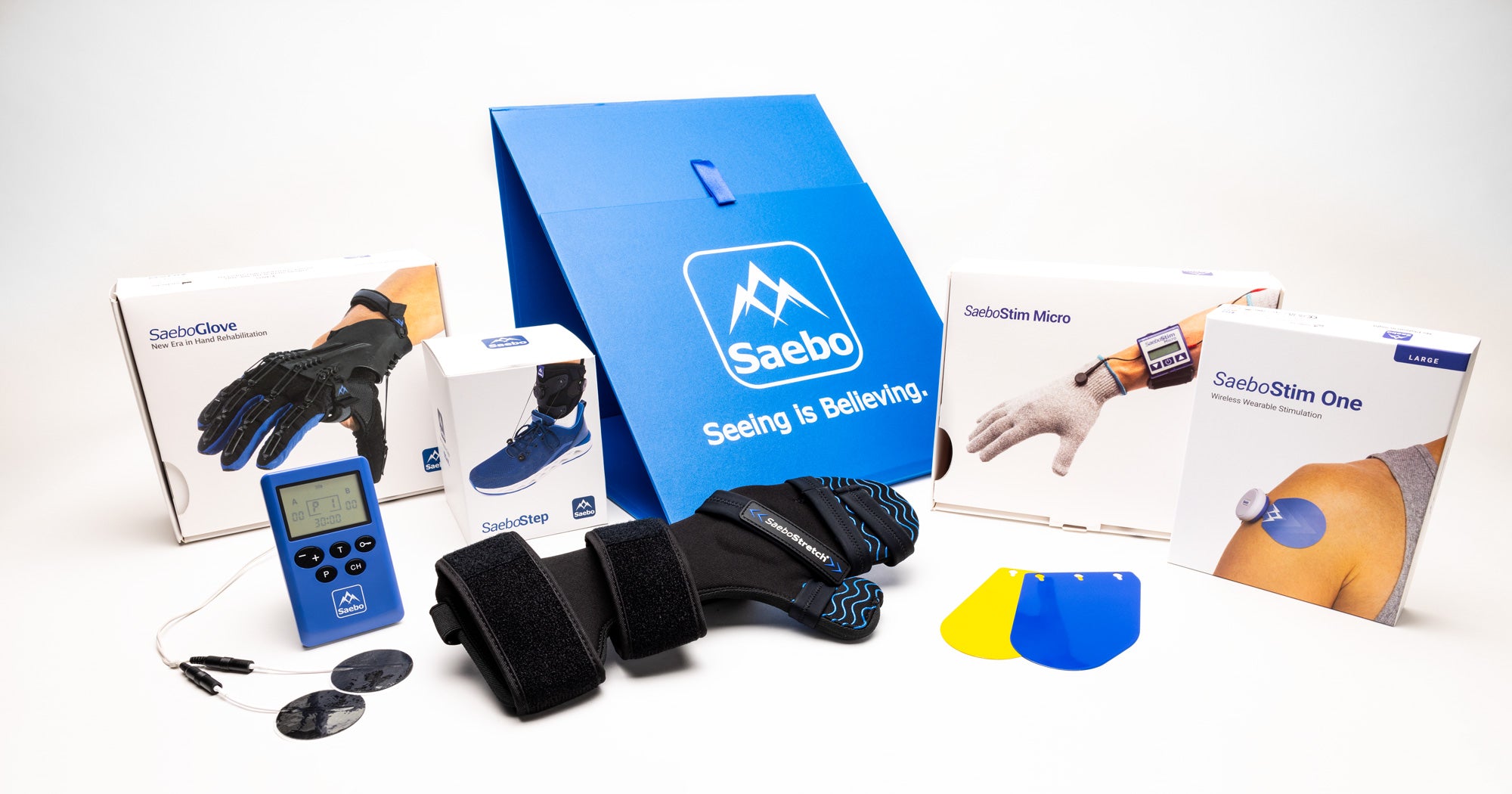
For individuals working on regaining arm and hand function, Saebo offers rehabilitation tools and orthotic devices designed to support active movement practice during recovery. Products such as the SaeboGlove can help support hand opening and grasp during functional exercises, while the SaeboFlex is designed to assist individuals with more significant hand tightness or weakness in practicing reach-and-grasp activities.
The SaeboReach can also help support upper extremity movement training by assisting elbow and hand positioning during repetitive practice. These tools can help patients engage the affected arm more effectively during bilateral and task-specific exercises, especially when active hand movement is limited. By increasing participation of the weaker side, they can help maximize the benefits of high-repetition training and support carryover into daily activities.”
Conclusion
Bilateral arm training is an evidence-based stroke rehabilitation strategy that may help improve arm strength, coordination, and functional recovery after stroke. The research shows major benefits, especially when you use higher doses and task-specific activities relevant to daily life. You might be a clinician looking to expand your therapeutic toolkit or a stroke survivor seeking effective rehabilitation strategies. Either way, bilateral movement exercises should be central to your recovery program. Starting with simple bilateral movement exercises and progressing gradually over time may help stroke survivors rebuild movement patterns and improve daily function. For many stroke survivors, repetitive bilateral practice may help stimulate neuroplasticity and unlock meaningful improvements in arm and hand function over time.
Many clinicians combine bilateral training with evidence-based rehabilitation tools and home exercise programs from Saebo to encourage repetitive task-specific practice and long-term recovery.
Todo el contenido de este blog es únicamente informativo y no sustituye el consejo, diagnóstico ni tratamiento médico profesional. Consulte siempre con su médico u otro profesional de la salud cualificado si tiene alguna pregunta sobre una afección médica. Si cree que puede tener una emergencia médica, llame a su médico o al 911 de inmediato. Confiar en la información proporcionada por el sitio web de Saebo es bajo su propio riesgo.
