
Stroke Hand Recovery and Daily Living Independence Using the SaeboGlove
Many adults need help with daily activities as they get older, especially after health events like stroke or injury. The need for assistance tends to increase with age, particularly in people over 75, where maintaining independence in everyday tasks like dressing, eating, and bathing becomes more challenging. These statistics highlight how functional independence declines with age—and why restoring hand function after stroke or neurological injury is critical for maintaining quality of life.
For individuals recovering from stroke, one of the most significant challenges is regaining hand movement, grip strength, and finger extension needed for everyday tasks. This is where targeted rehabilitation tools, such as the SaeboGlove, play an important role in supporting stroke hand recovery and upper limb rehabilitation.
Understanding Hand Impairment and Its Impact on Independence
Stroke and neurological conditions often disrupt the brain’s motor control system, leading to weakness or paralysis on one side of the body. Stroke and neurological conditions disrupt the brain’s motor control system, often leading to weakness or paralysis on one side of the body. Upper limb impairment occurs in roughly 70–80% of people in the acute phase, with the hand typically being the most affected area [1].
Damage to the motor cortex disrupts communication with hand muscles, making fine motor control, grip precision, and finger coordination difficult. Many survivors also experience hemiparesis, reduced sensation, poor proprioception, and wrist instability, all of which limit functional hand use.
The Link Between Hand Function and Daily Independence
Hand function is a key predictor of independence after stroke. Only a small percentage of survivors fully regain upper limb function, while many require ongoing assistance or long-term care.
Essential activities such as eating, dressing, grooming, bathing, and toileting all depend on functional grasp, release, and fine motor control. Even small impairments in hand use can significantly reduce independence in daily living tasks.
Why Repetitive Practice Matters for Recovery
Stroke recovery depends heavily on repetition. Research suggests that effective rehabilitation often requires hundreds of task-specific repetitions per day, with many survivors benefiting from 300–600 meaningful movement attempts per session [2].
This high-repetition training helps rebuild strength, improve coordination, and prevent “learned nonuse,” where the affected hand becomes progressively less active over time. Repeated functional movement is one of the strongest drivers of stroke hand recovery and motor relearning.
The Role of Neuroplasticity in Regaining Function
Neuroplasticity is the brain’s ability to reorganize and form new neural connections after injury. Following a stroke, the brain remains capable of adaptation, but it responds best to consistent, task-specific practice.
Each repetition strengthens neural pathways that control movement. With ongoing rehabilitation, survivors can continue improving hand function and upper limb control well beyond the early recovery phase, often for months or even years after stroke.
How the SaeboGlove Works as a Hand Orthosis
What the SaeboGlove is and how it provides finger extension support
The SaeboGlove is a lightweight hand rehabilitation glove designed to help people with weak hand function practice grasp-and-release movements more effectively during daily tasks and therapy.
Inside the glove are soft elastic bands, called tensioners, that attach to the fingers and thumb. When you close your hand around an object, these bands stretch. When you let go, they gently assist the fingers in returning toward an open position. This makes it easier to complete repeated grasp-and-release practice when finger extension is limited.
The glove is secured with a wrist support that helps keep the hand in a functional position during activity. It’s designed to be low-profile, so it can be worn during functional tasks like reaching, picking up objects, or practicing therapy exercises at home.
What makes it useful is not passive movement—it’s that it helps you practice active hand use when opening the hand is difficult, allowing more repetitions of real-world movement without needing full finger control each time.
The level of support can also be adjusted. Different tensioner sizes can be used depending on how much help is needed, and they can be changed as hand function improves over time.
In short, it doesn’t move the hand for you—it helps make repetitive grasp-and-release practice possible when hand opening is limited, so you can train function through real activity.
How the SaeboGlove Supports Daily Activities and Functional Independence
The SaeboGlove is designed to support stroke hand recovery and upper limb rehabilitation by enabling more effective participation in real-world activities. Rather than acting as a static brace, it assists with finger extension and functional grasp, allowing users to actively practice daily movements that drive neuroplasticity and recovery.
By improving the ability to open the hand, grasp objects, and release items more effectively, the SaeboGlove helps bridge the gap between impairment and independence across both basic and complex daily activities.
The SaeboGlove supports independence in essential self-care tasks by making grasp-and-release movements more controlled, repeatable, and functional during everyday activities.
In practical use, this means greater ease with eating and drinking. The glove helps stabilize the hand during grasp and improves release control, making it easier to hold utensils, scoop food, and manage cups without dropping objects.
It also carries over into grooming and hygiene tasks, where fine motor control is required. By assisting with finger extension and pinch ability, it becomes easier to handle small items like toothbrushes, combs, and other personal care tools.
During dressing tasks, the glove supports the ability to grasp fabric, manage clothing fasteners, and release items once positioned. This helps with everyday activities like buttoning, zipping, and adjusting clothing.
It also plays a role in bathing and toileting routines by improving the ability to grasp washcloths, manage clothing during transfers, and handle hygiene-related objects more safely and independently.
Overall, the benefit is consistent across all ADLs: it helps turn limited hand opening into usable function, so everyday tasks become more manageable through repetition and active use.
How the SaeboGlove Supports Object Control and Functional Training
A major benefit of the SaeboGlove is that it enables more consistent grasp-and-release practice, which is one of the most important foundations of stroke hand recovery and upper limb rehabilitation.
By supporting finger extension during activity, it allows users to more easily pick up and release small objects, maintain a more controlled grip on everyday items, and repeat hand movements that would otherwise be too difficult. Over time, this makes it possible to progress from simple object handling to more complex, coordinated tasks that require timing and control.
This kind of repetitive, task-based practice is what drives improvements in hand coordination, motor relearning, and neuroplasticity, especially when integrated into real daily activities rather than isolated exercise.
How It Helps with Instrumental Daily Activities (IADLs)
Beyond basic self-care, the SaeboGlove also supports more complex daily activities that are essential for independent living and community participation.
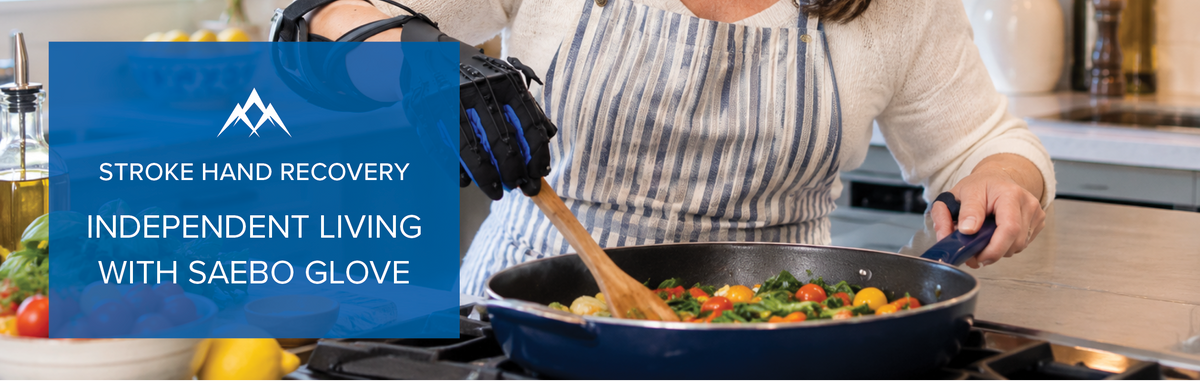
In the kitchen, it helps with gripping utensils, stabilizing objects, and managing lighter cooking tasks, making meal preparation more manageable and safer. At home, it carries over into everyday chores like folding laundry, light cleaning, and organizing items, where repeated grasp and release is needed for control and efficiency.
It also supports medication management by improving the ability to handle pill organizers, open containers, and manipulate small items that require precision. In a similar way, it can make technology use more accessible, including holding phones, tapping screens, and performing light typing or navigation tasks.
Beyond functional necessities, it extends into meaningful lifestyle activities as well. Gardening, crafts, and other hobbies become more accessible, which is important not only for physical recovery but also for maintaining motivation and long-term engagement in rehabilitation.
Why This Matters for Stroke Recovery
The value of the SaeboGlove is not just in support—it’s in making repetition of meaningful movement possible during real daily life, which is one of the most important drivers of stroke hand recovery.
When the hand is assisted into more usable motion, it allows for more consistent practice of grasp-and-release patterns throughout the day. Over time, this repeated use helps the brain and nervous system rebuild movement pathways through neuroplasticity, the process where the brain adapts by strengthening and reorganizing connections in response to practice and experience.
Every supported activity contributes to:
- Improved grasp and release control
- Increased use of the affected hand in real-world settings
- Reinforcement of neuroplasticity through repeated task-specific movement
- Greater independence in daily activities and routines
By turning everyday tasks into opportunities for structured movement practice, the SaeboGlove helps integrate rehabilitation into normal life—so recovery is no longer separate from daily living but built directly into it.
Conclusion
The SaeboGlove helps bridge the gap between current hand function and the independence you’re working toward after stroke or neurological injury. By supporting grasp-and-release during real daily activities, it makes it easier to build consistent repetition into everyday life—something that is essential for recovery.
This kind of repeated, task-based practice is what drives meaningful change in the brain through neuroplasticity, helping strengthen and rebuild the movement pathways needed for hand use. Whether it’s basic self-care tasks or more complex activities like cooking, cleaning, or hobbies, each repetition adds up over time.
With a structured home program that matches your goals—and guidance from an occupational therapist—hand recovery becomes a practical, step-by-step process rather than an uncertain outcome.
References
Todo el contenido de este blog es únicamente informativo y no sustituye el consejo, diagnóstico ni tratamiento médico profesional. Consulte siempre con su médico u otro profesional de la salud cualificado si tiene alguna pregunta sobre una afección médica. Si cree que puede tener una emergencia médica, llame a su médico o al 911 de inmediato. Confiar en la información proporcionada por el sitio web de Saebo es bajo su propio riesgo.
