
Stroke Recovery and Neuroplasticity: Why Repetition Is Essential for Brain Rewiring After Stroke
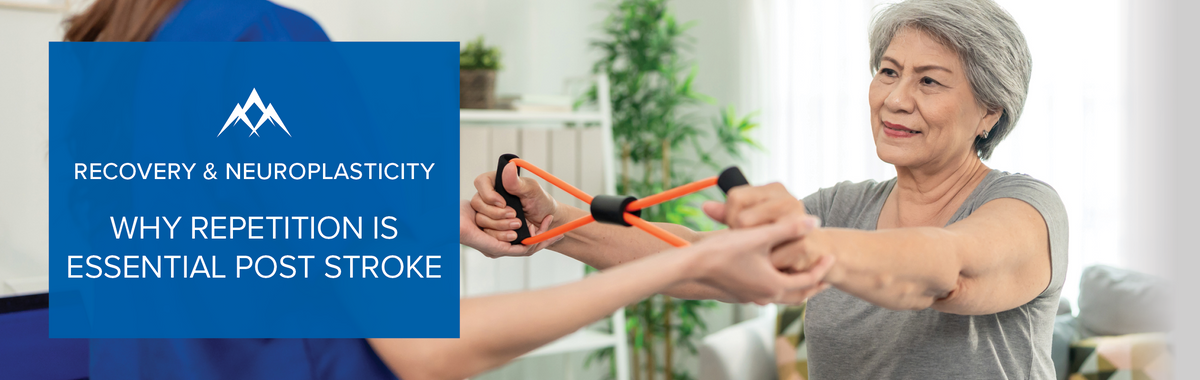
One of the most important truths about stroke recovery is this: neuroplasticity depends less on how many therapy sessions you complete and far more on what you practice repeatedly every day between them.
Stroke remains the second leading cause of death worldwide. Beyond survival, the primary challenge for most survivors is regaining meaningful function—especially movement of the arm and hand.
Research consistently shows that stroke survivors who engage in high-repetition, task-specific rehabilitation exercises experience greater improvements in motor recovery [1]. This is because repetition drives neuroplasticity—the brain’s ability to reorganize and form new neural connections after injury.
In this article, we will cover:
- What happens in the brain after stroke
- How neuroplasticity enables recovery
- Why repetition is the foundation of motor relearning
- How many repetitions are needed for meaningful change
- Stroke recovery exercises that improve function
- Common mistakes that slow progress
- How to structure an effective at-home rehabilitation plan
What Happens in the Brain After Stroke
During a stroke, blood flow to part of the brain is blocked or reduced, depriving neurons of oxygen and glucose. This quickly disrupts normal cell function and triggers a chain reaction of damage, including calcium imbalance, oxidative stress, and energy failure within the cells. When the interruption is severe or prolonged, it can lead to permanent cell death in the core area of the stroke.
The effects of stroke depend on location:
- A left hemisphere stroke often causes right-sided weakness, language difficulties (aphasia), and impaired reading or writing
- A right hemisphere stroke often causes left-sided weakness, spatial neglect, and attention deficits
The brain controls movement in a cross-wired system: each hemisphere primarily controls the opposite side of the body.
After stroke, inflammation spreads around damaged tissue. In the days and weeks that follow, the brain enters a highly dynamic repair state where some cells are removed, while others begin adapting to support recovery.
Stroke Recovery Stages and Brain Plasticity
Stroke recovery is not a single linear process. Instead, it typically unfolds across three overlapping stages, each characterized by different levels of brain plasticity, healing potential, and responsiveness to rehabilitation.
Understanding these stages helps explain when and how neuroplasticity is most active—and why repetition and task-specific training matter at every phase.
1. Acute Stage (0–1 month)
The acute stage begins immediately after the stroke and is dominated by medical stabilization and early brain recovery.
- Significant brain inflammation and metabolic disruption occur as damaged tissue responds to injury
- Blood flow restoration and cellular repair processes begin
- Neural activity is often suppressed in affected regions (“neural shock”)
- Movement may be significantly limited or completely absent in the affected limbs
During this phase, the brain is highly vulnerable, but early neural recovery processes are already being initiated beneath the surface.
2. Subacute Stage (1–6 months)
The subacute stage is widely considered the most important window for neuroplastic change and functional recovery.
- Peak neuroplasticity occurs, with heightened synaptic responsiveness and cortical reorganization
- Spontaneous recovery is often most noticeable during this period
- Patients typically show the greatest response to rehabilitation and task-specific training
- Repetitive movement and intensive therapy strongly influence motor relearning outcomes
This is the phase where the brain is most adaptable, meaning high-repetition, task-specific stroke rehabilitation exercises can produce significant functional gains, especially for upper extremity recovery.
3. Chronic Stage (6+ months)
The chronic stage begins after the initial recovery window, but it does not mean recovery has stopped.
- Neuroplasticity continues at a slower but still meaningful rate
- Improvements depend heavily on training intensity, repetition volume, and task specificity
- Functional gains remain possible months or even years after stroke with consistent practice
- Learned non-use patterns can still be reversed with targeted rehabilitation strategies
Even in this later stage, the brain retains the ability to reorganize and form new connections when sufficiently challenged through structured rehabilitation.
How Neuroplasticity Works After Stroke
Neuroplasticity refers to the brain’s ability to reorganize its structure and function in response to injury or learning.
After stroke, recovery is driven by several key mechanisms:
- Synaptogenesis – formation of new synaptic connections
- Dendritic remodeling – growth and reshaping of neuron branches
- Cortical reorganization – re-mapping of brain functions to healthy regions
- Axonal sprouting – growth of new neural pathways
Perilesional areas (regions surrounding the injury) and even the opposite hemisphere can take over lost functions through training and repetition.
Without rehabilitation, however, the brain can reinforce maladaptive patterns such as compensatory movement strategies or learned non-use of the affected limb.
Why Repetition Is the Foundation of Stroke Recovery
The principle behind neuroplasticity is simple:
“Neurons that fire together wire together.”
This concept explains how repeated activation of neural pathways strengthens connections over time.
When a movement is repeated consistently:
- Synapses become stronger
- Neural firing becomes more efficient
- Motor patterns become more automatic
- Functional movement begins to return
Repetition is not optional in stroke recovery—it is the mechanism by which the brain relearns movement.
How Many Repetitions Are Needed for Stroke Recovery?
Research from motor learning and neurorehabilitation suggests:
- 300–600 task-specific repetitions per session may be required for meaningful upper extremity recovery
- High-frequency daily practice is more effective than occasional therapy
- Greater repetition volume is associated with improved cortical reorganization
Research in stroke rehabilitation consistently shows that high-volume, task-specific repetition is necessary to drive meaningful improvements in motor function, particularly for the arm and hand [2]. In practice, recovery is strongly influenced by the total amount of purposeful movement completed throughout the day, not just during formal therapy sessions.
However, in many clinical settings, structured therapy time alone is not enough. Typical sessions may include only a limited number of functional repetitions—often around 30–50 task-specific movements—depending on fatigue, severity of impairment, and session structure. While these sessions are important for guidance and progression, this volume alone is generally insufficient to fully stimulate the level of neuroplastic change needed for optimal recovery.
This is why additional daily practice outside of therapy is essential. Repetition accumulated at home through self-directed exercises and real-world task practice significantly increases total movement dosage and is a key driver of improved functional outcomes over time.
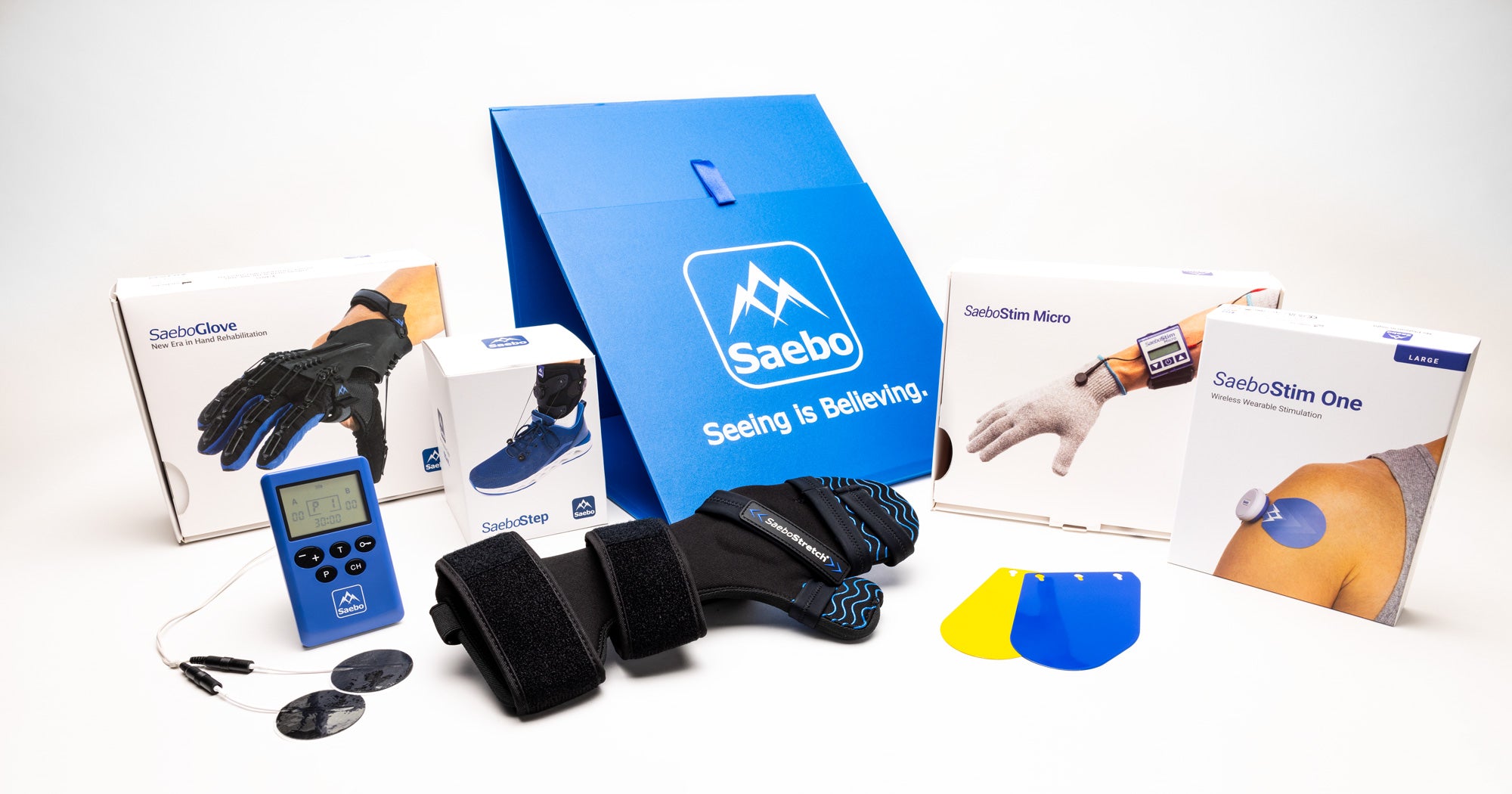
Because achieving hundreds of daily repetitions can be challenging with significant weakness or spasticity, many stroke survivors benefit from assistive rehabilitation tools that enable higher-quality movement practice at home, such as Saebo upper extremity training devices.
Stroke Recovery Exercises That Promote Neuroplasticity
Effective stroke recovery exercises for neuroplasticity are not random movements—they are task-specific, repetitive, and progressively challenging activities designed to retrain the brain and improve functional use of the affected arm and hand. The goal is to increase daily movement volume while reinforcing correct motor patterns through repetition, which supports upper extremity stroke recovery and reduces learned non-use.
These exercises are most effective when performed consistently throughout the day, not only during structured therapy sessions. Increasing total repetition dose is a key driver of neuroplastic change and long-term functional improvement.
Hand and Finger Stroke Recovery Exercises
Hand function is often one of the most affected areas after stroke, making high-repetition training essential for regaining dexterity and control.
- Finger extension and opening practice (50–100 repetitions) to improve active hand opening
- Picking up and releasing small objects (100–200 repetitions) to retrain grasp-and-release coordination
- Squeezing and releasing therapy putty or soft objects to strengthen grip endurance and improve motor control
These exercises help rebuild fine motor pathways in the brain and are especially important for improving stroke hand recovery and grip function.
Arm and Shoulder Stroke Rehabilitation Exercises
Shoulder and arm recovery requires larger movement patterns that re-establish reaching, lifting, and coordinated upper limb control.
- Reach-and-grasp training using cups, cones, or household objects (100–200 repetitions)
- Towel slide shoulder flexion exercises (approximately 100 repetitions) to support smooth shoulder activation
- Bilateral arm reaching tasks (100–150 repetitions) to encourage symmetry and improve interhemispheric coordination
These movements are essential for restoring functional upper extremity use in daily activities such as reaching, lifting, and carrying.
Functional Task-Based Stroke Recovery Training
Functional, real-world practice is one of the most effective ways to promote task-specific neuroplasticity after stroke. These activities directly translate to daily independence and help reinforce meaningful motor patterns.
Examples include:
- Turning pages in a book or magazine
- Lifting, carrying, and placing household objects
- Simulated dressing, grooming, or kitchen-related tasks
Because these exercises closely mirror daily life, they help bridge the gap between clinical rehabilitation and real-world functional recovery.
Constraint-Induced Movement Therapy (CIMT) and High-Repetition Training
Constraint-Induced Movement Therapy (CIMT) is a well-established approach in stroke rehabilitation that promotes recovery by encouraging consistent use of the affected arm while limiting compensation from the stronger side.
This method is highly effective because it significantly increases daily repetition volume of the affected limb, which is a key driver of neuroplastic change.
Supportive rehabilitation tools and systems, including those developed by Saebo Inc, can help facilitate structured upper limb engagement, improve repetition quality, and support at-home stroke recovery programs. For individuals with limited finger extension or difficulty initiating movement, adaptive rehabilitation tools such as SaeboGlove or SaeboMAS can help facilitate active-assisted movement and increase repetition volume during stroke recovery exercises.
How to Maximize Neuroplasticity After Stroke
To improve recovery outcomes:
- Stay mentally focused during each repetition
- Increase task difficulty gradually over time
- Combine physical practice with motor imagery
- Use meaningful, real-world tasks
- Track repetitions and progress consistently
Neuroplasticity is driven by intensity, repetition, and specificity, not passive movement.
Frequently Asked Questions
Can the brain rewire after stroke?
Yes. The brain can reorganize itself for months and even years after stroke through neuroplasticity.
How many repetitions are needed for stroke recovery?
Most research suggests 300–600 daily task-specific repetitions may be required for upper limb recovery.
What are the best stroke recovery exercises?
Repetitive reach, grasp, finger extension, and functional task-based training are most effective.
Does repetition really improve stroke recovery?
Yes. Repetition strengthens neural pathways and promotes cortical reorganization.
Conclusion
Stroke recovery is not passive—it is built through intentional, high-repetition, task-specific training that directly drives neuroplasticity in the brain.
While early recovery phases offer heightened responsiveness, the brain retains the ability to adapt long after stroke when properly challenged.
Key drivers of recovery include:
- High repetition volume
- Task-specific movement
- Progressive difficulty
- Consistent daily practice
- Active engagement of the affected limb
Integrating structured rehabilitation strategies and upper extremity training tools from Saebo Inc can further support recovery and help reduce learned non-use.
References
Todo el contenido de este blog es únicamente informativo y no sustituye el consejo, diagnóstico ni tratamiento médico profesional. Consulte siempre con su médico u otro profesional de la salud cualificado si tiene alguna pregunta sobre una afección médica. Si cree que puede tener una emergencia médica, llame a su médico o al 911 de inmediato. Confiar en la información proporcionada por el sitio web de Saebo es bajo su propio riesgo.
