
Core & Balance Exercises for Stroke Recovery: Functional Stability Training for Neurological Rehabilitation
Introduction
Stroke affect nearly 12 million people worldwide each year, and deficits in core stability often predict whether patients regain independence or experience difficulty with mobility and balance (1). Falls occur in nearly 40% of post-stroke patients, and over 80% experience balance disturbances in the subacute phase (2, 3). Six months after stroke, many still have difficulty with simple activities of daily living.
Trunk control is often the missing link in stroke rehabilitation. Core stability exercises improve sitting balance, standing tolerance, gait quality, and reduce fall risk in neurological patients. In this guide, we’ll explain why core stability matters after stroke, outline effective core and balance exercises, and show how to safely progress from supported positions to more dynamic, task-based movement.
Why Core Stability Matters
What is Core Stability in Neurorehabilitation
Core stability in neurorehabilitation refers to how the muscles of the trunk work together to support the spine and maintain posture during movement. The core includes the muscles of the abdomen, back, and pelvis, which create a stable base for all functional activities.
In neurological recovery, core stability training goes beyond general fitness. It focuses on improving muscle coordination and timing so the body can properly prepare for movement. The nervous system must relearn how to activate core muscles before moving the arms or legs. This helps provide stability, reduce compensatory patterns, and improve overall movement quality.
The trunk also plays a key role in balance and postural control. It helps stabilize the body and maintain orientation during movement. When trunk control is impaired, balance becomes less efficient, and patients may rely on less effective movement strategies, increasing the risk of instability and falls.
How Trunk Weakness Affects Balance
Trunk control shows moderate to strong associations with balance and functional mobility in neurological populations. Stroke patients demonstrate decreased activity in lateral trunk muscles, delayed onset of contraction, and loss of synchronization between paired muscles. Abdominal muscle thickness often decreases on the affected (hemiplegic) side compared to the unaffected side.
These impairments create measurable functional losses. Trunk control is strongly linked to static, dynamic, and functional balance performance. Patients with reduced trunk stability struggle to maintain their center of gravity during gait, and walking quality deteriorates. Beyond balance deficits, impaired trunk control predicts difficulty with activities of daily living and increases fall risk toward the involved side.
Sitting lateral balance control appears sensitive to stroke-related changes. Patients show increased frontal plane movements but reduced sagittal plane movements compared to healthy controls. This altered movement pattern reflects the loss of coordinated trunk muscle activation. Trunk muscle dysfunction also contributes to increased fall risk in other neurological conditions, such as Parkinson’s disease.
Saebo Support for Early Core Engagement
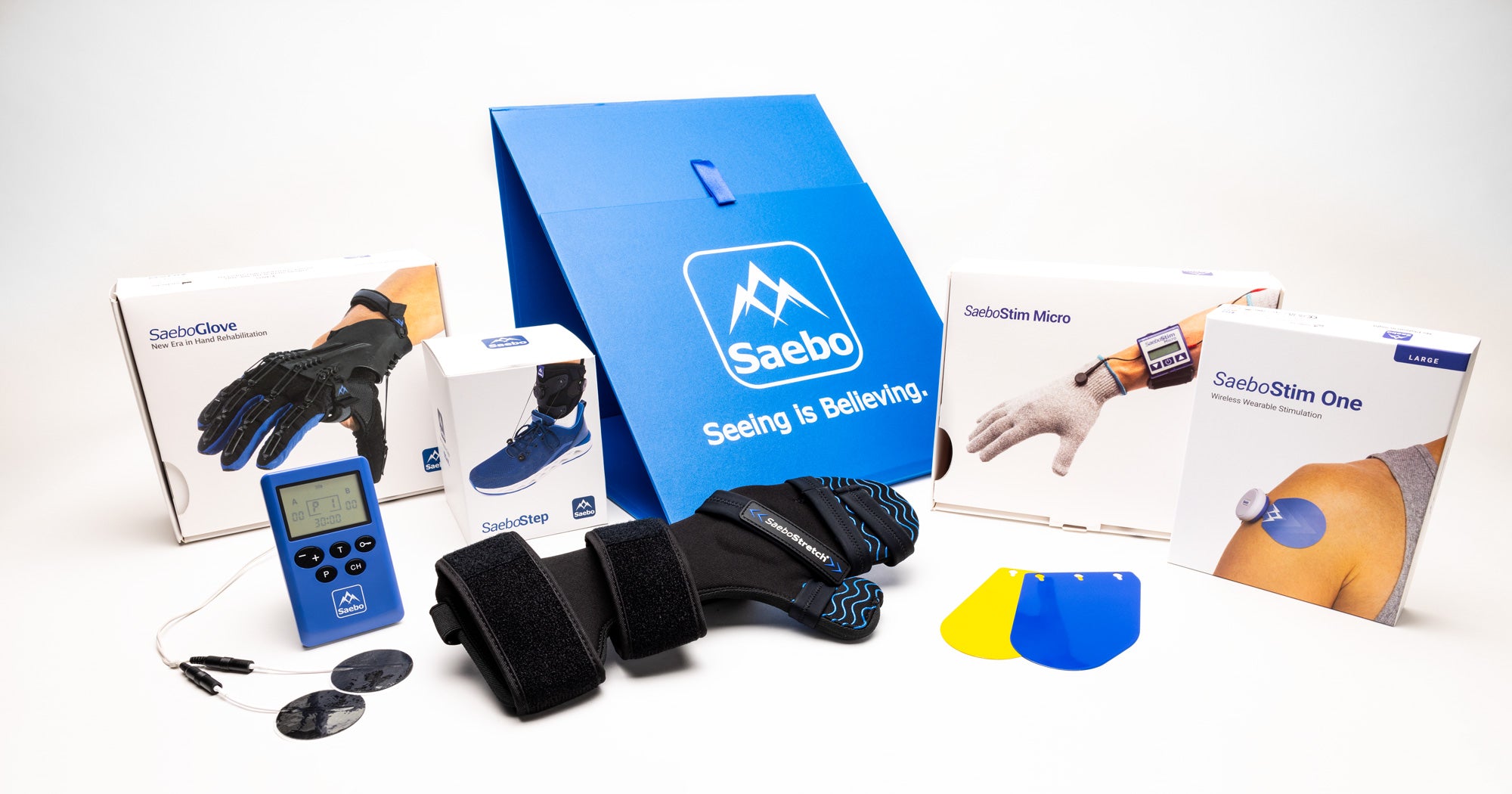
Saebo products, including SaeboStep, SaeboFlex, and SaeboGlove, are widely used in stroke rehabilitation as adjuncts to core and balance training, helping enable task-specific, repetitive practice. The SaeboStep supports safe gait training while patients work on dynamic balance and weight shifting. This allows therapists to progress core exercises from static sitting to standing and walking without compromising safety.
Upper extremity devices such as SaeboFlex and SaeboGlove facilitate bilateral arm engagement during dynamic balance and trunk control exercises, supporting neuroplasticity and functional recovery. Reaching activities with arm support reinforce postural control and trunk symmetry, and this addresses the neurodevelopmental principle that extremity movements proceed from proximal to distal body parts. These tools support the affected limb and allow patients to practice reaching outside their base of support. This helps activate core muscles during real-life movements rather than isolated exercises, improving carryover to daily activities.
The Neuro Connection: Core Training and Recovery
Nervous System Control of the Trunk
The trunk and limbs are closely connected through the nervous system, meaning movement in one area influences the other. This neural mechanism means arm movements influence trunk muscle activation and vice versa. Motor evoked potentials in trunk extensor muscles increase before or during voluntary arm movements. The brain prepares the trunk before it initiates limb actions. This crossed facilitation becomes especially relevant during reaching tasks that require trunk muscle activity concurrent with arm movements.
Spinal cord injury research reveals the complexity of this system. Subjects with cervical SCI who managed to keep crossed facilitation showed quicker anticipatory postural adjustments during functional arm movements. Those with greater facilitation in trunk extensors moved their trunk further during forward-reaching tasks. Corticospinal axons branch to multiple motoneuron pools and distribute across several spinal levels. This creates interconnected motor circuits rather than isolated segments.
Different types of core exercises activate the brain and nervous system in different ways. Conscious exercises mainly engage the cortical motor network. Subconscious core stabilization recruits both cortical areas and subcortical networks including the cerebellum, basal ganglia, thalamus and cingulate cortex.
Core Stability and Neuroplasticity
Task-specific, repetitive practice creates neuroplasticity through core stability training. Core stability exercises added to usual care physiotherapy improved trunk control and functional dynamic balance in stroke patients. Some studies show meaningful improvements in walking speed and functional mobility (4). Trunk training exercises showed moderate evidence for improving trunk performance and dynamic sitting balance.
Experience-dependent plasticity drives this mechanism. Repeated trunk muscle activation strengthens neural connections and reorganizes motor networks. Undamaged brain areas compensate for lost functions through functional reorganization. The brain redistributes tasks in response to injury. This is often called use-dependent plasticity—the more you practice a movement, the stronger those pathways become. The movements we practice consistently become the pathways the brain prioritizes.
Trunk training influences multiple outcomes beyond core function. Studies show improvements in activities of daily living, standing balance, leg function and quality of life. The training restores trunk muscle activation patterns and improves anticipatory adjustments to perturbations. Trunk muscle thickness symmetry increases.
Key Core Exercises for Neuro Patients
Sitting balance exercises for stroke patients progress from supported to independent positions. Begin with trunk rotation with posterior support, then advance to reaching and weight-shifting tasks to enhance core stability and functional balance. Progress to reaching behind for objects or placing items into containers to challenge balance and coordination. Elbow-to-object touches challenge lateral weight shifting without hand support.
Dynamic core exercises include catching balls with Velcro paddles at varying heights and distances, integrating task-specific training to improve postural control and balance after stroke. Place rings on poles while you maintain sitting balance. Controlled forward trunk flexion with assisted return to upright works well. Activities like reaching overhead or shooting a ball can help challenge upper-level balance and trunk control.
Neuromodulation techniques, such as electrical stimulation, may also support trunk activation in some neurological populations. Functional electrical stimulation and transcutaneous spinal cord stimulation improved trunk stability, sitting balance and muscle activation in individuals with trunk paralysis. These adjunct therapies work by directly activating weakened trunk muscles during functional tasks. They enhance traditional exercise approaches.
Functional Balance Training: From Static to Dynamic
Starting with Supported Positions
Balance retraining begins where patients can safely maintain postural control. Sitting exercises form the foundation, but the difference between passive and active sitting determines outcomes. Passive sitting occurs when a patient is reclined and not actively engaging their muscles to maintain posture. This causes decreased eye contact, limited lung expansion, and flexion contractures over time.
Active sitting changes the picture. Position the pelvis in a forward-angled tilt and secure it at the back of the chair seat. Plant feet on the floor or footboard to stabilize and balance the body. When you place forearms on a tray, arms can assist with weight-bearing and establish better postural control of the upper body, neck, and head. This foundation improves respiration and communication.
Conventional stroke balance training progresses from sitting-to-stand transitions to single-leg stance exercises using both affected and unaffected limbs, including variations on stools, foam pads, or rocker boards to challenge postural control. Foot stance progressions rank in order of difficulty: feet apart, feet together, semi-tandem Romberg, tandem Romberg, and single leg stance.
Progressing to Standing and Anti-Gravity
As patients build core strength, the next step is moving into standing and more dynamic balance work. Tools like anti-gravity treadmills can make this transition safer by reducing body weight, which helps patients practice walking and balance with less strain or fear of falling.
These sessions typically last 20 to 60 minutes and can be adjusted based on each patient’s comfort level. Over time, this type of training helps strengthen key leg muscles and improves walking ability and balance after stroke.
It also supports balance by helping the body better process movement and position. For patients progressing to overground walking, tools like the SaeboStep provide added support, making it easier to practice safe, dynamic balance and build confidence during gait training.
Task-Oriented Activation
Task-oriented training improves muscle activation patterns during functional activities. Perturbation-based training focuses on practicing responses to instability through external forces like pushing or pulling and internal perturbations from rapid movements. Additionally, dual-task exercises combine balance work with cognitive demands and improve both postural control and mental processing under real-life conditions.
Conclusion
Core stability and functional balance exercises transform stroke rehabilitation by targeting trunk control deficits that affect gait, postural stability, and independence. You build the foundation for functional carryover by progressing patients from supported sitting to dynamic, task-oriented movement. This foundation matters because it leads to safer gait, reduced fall risk, and improved daily living skills. Research consistently supports this approach for improving balance, mobility, and independence after stroke. Begin at the patient’s current functional level and gradually progress core and balance exercises to support long-term recovery and independence.
References
Todo el contenido de este blog es únicamente informativo y no sustituye el consejo, diagnóstico ni tratamiento médico profesional. Consulte siempre con su médico u otro profesional de la salud cualificado si tiene alguna pregunta sobre una afección médica. Si cree que puede tener una emergencia médica, llame a su médico o al 911 de inmediato. Confiar en la información proporcionada por el sitio web de Saebo es bajo su propio riesgo.
