
Stroke Arm Exercises in Daily Activities: A Step-by-Step Guide for Hand and Arm Recovery After Stroke
Stroke arm exercises matter, especially since more than 795,000 people in the United States experience a stroke each year, often leading to hand and upper extremity weakness that affects daily activities. Limited arm mobility after stroke can make everyday tasks like brushing hair, pouring cereal, or using a phone difficult without targeted stroke rehabilitation exercises for the arm and hand.
But here's what makes a difference: integrating exercises for stroke into your daily routine rather than treating them as separate workout sessions. The core principle is consistent, task-specific practice, whether you are performing stroke arm exercises at home, hand exercises after stroke, or upper extremity occupational therapy exercises for hemiplegia.
In this piece, we'll show you practical ways to use your affected arm during everyday activities. This helps you rebuild function and regain independence.
Why Stroke Arm Exercises Prevent Learned Non-Use and Improve Recovery
After a stroke affects one side of the body, the brain is immediately challenged to adapt to reduced movement on the affected side. When early attempts to use the weaker arm are difficult or unsuccessful, the brain often begins to favor the stronger arm, reinforcing a pattern of compensation that can significantly reduce long-term recovery of the affected limb.
What Is Learned Non-Use and How It Limits Recovery
Learned non-use occurs after stroke when a person gradually stops using the affected arm due to repeated difficulty, even though stroke recovery exercises could still improve function. In the early stages of stroke recovery, the arm may be weak, flaccid, or have limited voluntary movement, making early stroke arm exercises especially important. Movement attempts feel effortless with your stronger side but exhausting with your affected side. Over time, the brain adapts by favoring the unaffected arm, reinforcing learned non-use and reducing opportunities for neuroplastic recovery in the affected arm.
So, your brain begins to suppress movement attempts with the weaker arm. This creates a destructive cycle. Decreased use guides you toward disadvantageous cortical reorganization, which further reduces use. The hand region of your motor cortex can be invaded by areas representing more proximal arm control. Recovery becomes even more difficult. This pattern results in muscle atrophy and joint stiffness over time. You also experience reduced range of motion and potentially contractures that cause chronic pain.
How Neuroplasticity Helps Your Brain Relearn Movement
Stroke recovery is possible due to neuroplasticity, the brain’s ability to reorganize and strengthen neural pathways through repeated stroke arm exercises and functional task practice. This process involves several mechanisms: synaptic plasticity (changes in synapse strength) and cortical remapping (where intact brain areas compensate for damaged regions). Surviving neurons also form new connections through axonal sprouting. Basically, this is what happens: the more you practice using your affected arm in meaningful ways, the more your brain physically rewires itself to improve movement and function over time.
You strengthen new pathways your brain is building when you attempt a task repeatedly. The brain is most responsive during the early post-stroke phase (typically the first 3–6 months), but neuroplasticity continues long-term with consistent stroke rehabilitation exercises. Rehabilitation can maximize recovery during this period. But neuroplasticity remains active throughout the chronic phase. Progress is still possible months or years later with consistent practice.
The Connection Between Repetition and Functional Improvement
Recovery depends less on how long therapy lasts. What matters most in stroke arm recovery is repetition—performing hundreds of meaningful, task-specific stroke arm exercises daily to drive neuroplastic change. Research on intensive motor training shows that people performing hundreds of functional repetitions per day often experience substantial improvement, with evidence suggesting that around 300–600 daily repetitions of stroke arm exercises may support meaningful gains in upper extremity function for individuals with mild-to-moderate impairment [1].
Task-specific training involves repetitive practice of ground tasks like reaching or grasping. This demonstrates that neuroplasticity is use-dependent. Neurons that fire together wire together, reinforcing neural pathways through practice. Repetitive task training has shown meaningful improvements in arm function and leg function after stroke.
Simple Ways to Use Post CVA Exercises in Everyday Tasks
Incorporating stroke arm exercises into daily activities is most effective when the affected arm is actively engaged—not just supported or passively positioned. The goal is to repeatedly involve the weaker arm in meaningful movement, even if it cannot fully complete the task. These small contributions add up to hundreds of repetitions that support neuroplastic recovery.
Morning Routine: Washing, Grooming, and Dressing
Instead of relying entirely on the stronger arm, begin by using the affected arm as an active participant in setup and stabilization.
- Use the affected hand to help stabilize clothing on your lap or body during dressing
- Practice bringing the affected hand toward the face or torso with assistance during grooming tasks
- Lightly rest or position the affected hand on grooming tools or surfaces to promote weight bearing and sensory input
- When possible, attempt bilateral movements, such as bringing both hands toward a shirt or face wash routine together
These strategies promote early stroke arm exercises through assisted movement, sensory activation, and bilateral coordination.
Mealtime Activities: Food Prep and Eating
During mealtime, the affected arm should be used as a helper limb for support, stabilization, or guided movement, even if grip is limited.
- Place the affected hand on bowls or cutting boards to encourage weight-bearing through the arm
- Use the affected arm to assist with stabilizing objects during reaching or scooping tasks
- During feeding or prep, guide the affected arm to move in the same direction as the stronger arm whenever possible
- Practice bringing both hands toward midline tasks, such as holding a cup or stabilizing a plate
This turns mealtime into structured upper extremity stroke rehabilitation rather than one-handed compensation.
Household Tasks: Cleaning and Organizing
Household activities are an opportunity to train reach, support, and assisted coordination in real environments.
- Use the affected arm as a light stabilizer on surfaces while the stronger arm performs the task
- Encourage weight-bearing through the affected arm on counters or furniture during breaks
- Guide the affected arm through assisted reaching patterns (even if range is limited)
- Use bilateral involvement when possible (both arms moving together, even if unevenly)
This helps reinforce functional movement patterns used in occupational therapy stroke rehabilitation.
Technology Use: Phone, Computer, and Remote Controls
Technology tasks can be modified to keep the affected arm neurologically engaged even without fine motor control.
- Rest the affected hand on the desk or device to promote sustained sensory input and weight bearing
- Use both hands for midline positioning tasks (holding tablet, stabilizing phone, supporting posture)
- Attempt assisted bilateral reaching toward devices or controls
- Pair active unaffected-hand use with intentional visual and motor attention to the affected arm
This supports motor planning recovery and reduces learned non-use patterns.
Leisure Activities: Hobbies and Social Involvement
Leisure activities are most beneficial when they include intentional use or involvement of the affected limb, not avoidance.
- Modify hobbies so the affected arm can assist in holding, stabilizing, or guiding objects
- Use bilateral participation in activities like gardening, cooking, or music whenever possible
- Engage in repetitive, meaningful movements that encourage functional use of both arms together
- Prioritize activities that require interaction, not isolation, of the affected limb
Even small involvement of the affected arm during enjoyable tasks strengthens adherence and increases repetition volume.
How to Modify Activities Based on Your Current Ability Level
Matching exercises to your current ability level prevents frustration and maximizes recovery potential. Exercises that are too easy don't stimulate neuroplasticity. Those beyond your capacity lead to compensation patterns and discouragement.
Stroke Arm Exercises for Severe Hemiplegia: Passive and Supported Movement Training Passive stroke arm exercises are often the starting point when there is little or no active movement in the affected arm after stroke. This involves your unaffected hand, a caregiver, or a therapist moving your affected limb through the joint's range of motion. Passive exercise stimulates neuroplasticity by activating sensory pathways and helps maintain joint flexibility. Start within 24 to 48 hours after your stroke once medically stable. You should do sessions of 15 to 40 minutes several times daily. Focus on shoulder shrugs with assistance, supported arm reaches on a table with a towel, and gentle wrist movements.
Exercises for Moderate Hemiparesis: Building Strength and Control
Active-assisted exercises bridge the gap between passive and independent movement once you regain some voluntary movement, usually about one week post-stroke. You initiate the movement and receive support to complete it safely. Practice cup-to-mouth movements with water or weights added for resistance, seated chest presses with a cane held at shoulder width, and bicep curls with a dowel. When properly guided, progressive stroke rehabilitation exercises do not increase spasticity and can support functional recovery of the arm and hand.
Exercises for Mild Weakness: Progressing to Fine Motor Skills
You can work on dexterity with improved strength. Therapeutic balls and putty offer graded resistance for hand exercises. Practice ball grips, pinch holds between thumb and fingers, and finger spreads. Use household items like water bottles for wrist curls and extensions, pens for spinning exercises, and coins for pinch-and-release tasks.
When to Progress to the Next Level
Advance once current exercises feel moderately easy rather than challenging. While the optimal window for intensive motor rehabilitation occurs in the first 6 weeks to 2 months after stroke onset, recovery can continue long-term.
How Saebo Helps Improve Arm Use
Stroke recovery is most effective when repetitive, task-specific stroke arm exercises are supported with tools that encourage active movement and neuroplastic engagement. Many individuals experience weakness, spasticity, or difficulty initiating hand and arm movement, which can limit progress during daily activities. Assistive rehabilitation technology can help bridge this gap by enabling more repetitions, improving movement quality, and supporting functional use of the affected arm.
Saebo develops stroke rehabilitation solutions designed to support upper extremity recovery through functional, activity-based training rather than passive support alone.
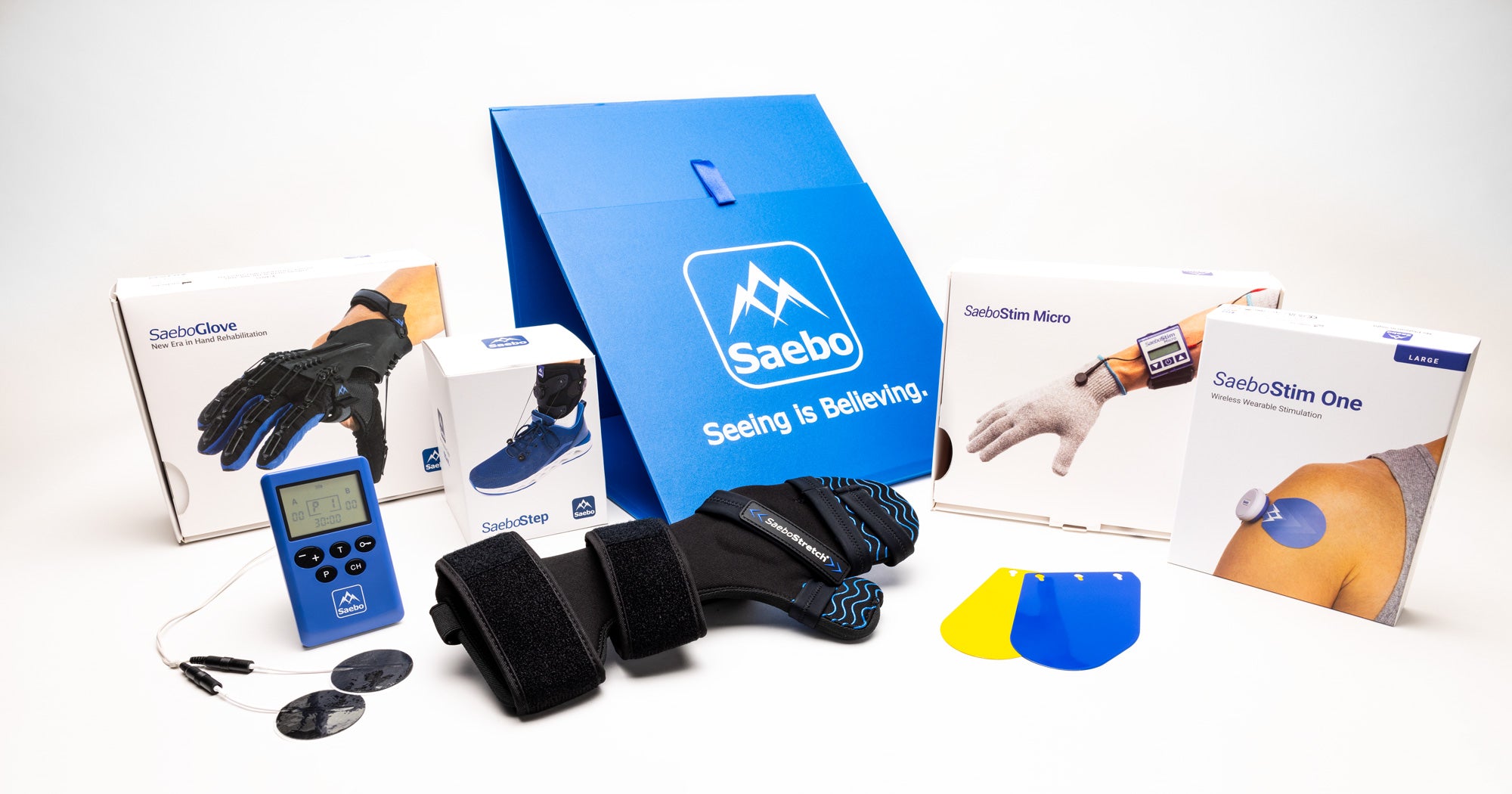
For example, SaeboGlove is commonly used in stroke hand rehabilitation to assist with grasp-and-release practice. This allows individuals with weak finger extension to perform more repetitions of functional hand exercises after stroke, which is critical for reinforcing neuroplasticity and improving hand function over time.
SaeboMAS (Mobile Arm Support) is designed to reduce the effects of gravity on the affected arm, making it easier to practice stroke arm exercises such as reaching, lifting, and controlled movement at the shoulder and elbow. This support enables individuals with moderate to severe weakness to engage in meaningful upper extremity training that may otherwise be too difficult.
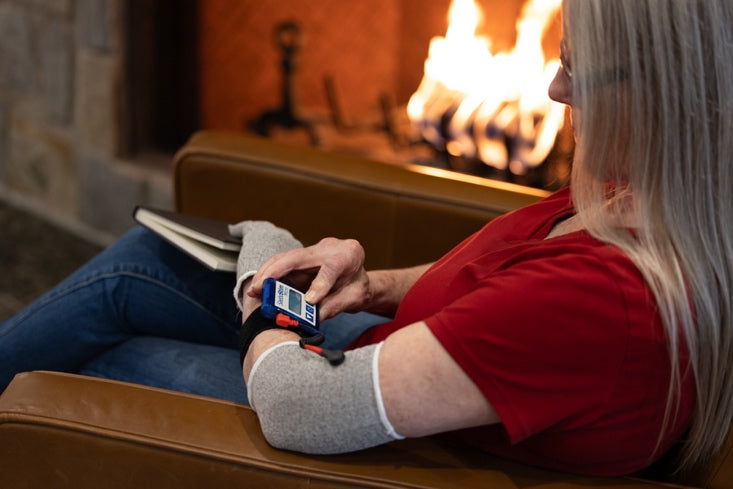
For individuals working on neuromuscular re-education, SaeboStim One may be used as part of a stroke rehabilitation program to help activate weakened muscles during movement practice. When combined with functional tasks, electrical stimulation can support motor re-education and improve voluntary control.
In addition to physical training, cognitive-based rehabilitation tools such as SaeboMind support mental practice and motor imagery exercises. These approaches help activate motor planning areas of the brain, reinforcing neuroplastic pathways even when physical movement is limited.
Together, these tools support a comprehensive approach to stroke recovery that combines repetition, task-specific training, and neuroplasticity-based rehabilitation principles. When integrated into daily routines, they can help individuals increase the number of meaningful stroke arm exercises performed each day, which is a key driver of functional improvement.
Conclusion
You now have a practical roadmap for turning everyday activities into powerful recovery opportunities. Your affected arm does not require separate workout sessions—consistent stroke arm exercises integrated into daily activities can drive meaningful recovery over time. Every meal you prepare and every shirt you button creates meaningful repetitions that rewire your brain. This approach aligns with occupational therapy principles and modern stroke rehabilitation programs focused on neuroplasticity, hand function recovery, and upper extremity re-engagement.
Stroke recovery is driven by consistency, repetition, and task-specific stroke rehabilitation exercises rather than perfect performance. Start where you are now, use your affected arm as much as safely possible, and progress at your own pace. Keep practicing and stay patient with yourself. Your functional independence will grow with time.
References
Todo el contenido de este blog es únicamente informativo y no sustituye el consejo, diagnóstico ni tratamiento médico profesional. Consulte siempre con su médico u otro profesional de la salud cualificado si tiene alguna pregunta sobre una afección médica. Si cree que puede tener una emergencia médica, llame a su médico o al 911 de inmediato. Confiar en la información proporcionada por el sitio web de Saebo es bajo su propio riesgo.
