
Neuroplasticity Exercises: The Science Behind Stroke Recovery at Any Age
For many stroke survivors, recovery doesn’t end after the first few months. The chronic stage of stroke recovery, starting around six months post-injury, may bring slower progress, but lasting improvements are still possible through consistent stroke rehab exercises. Cerebrovascular accidents (CVA) is a leading cause of disability and death, affecting nearly 12 million people worldwide each year, making stroke rehab exercises and neuroplasticity-based therapy critical for ongoing recovery. While early therapy is important, neuro rehabilitation exercises at home or in therapy can promote recovery throughout life, leveraging the brain’s ability to reorganize and form new neural pathways, a process called neuroplasticity.
The brain is most responsive to therapy during an early “sensitive window” about 60–90 days after an injury. However, research has shown that neuroplastic changes can occur well beyond this period. Even years after a stroke, the brain retains its capacity to adapt, rebuild connections, and restore lost functions especially with the right kind of targeted, consistent practice.
This guide explores how brain rewiring and chronic stroke rehab exercises support long-term recovery, offering practical exercises for individuals six months or more post-stroke. You’ll learn how to engage your brain’s healing ability with evidence-based CVA rehab exercises, including motor, cognitive, and technology-assisted approaches, effective months or even years after a neurological injury.
What is neuroplasticity and how does it work?
Neuroplasticity is the brain’s ability to reorganize and form new connections, which underlies effective stroke rehabilitation exercises and motor recovery. This process enables the brain to form alternative pathways around damaged areas, supporting motor, cognitive, and speech recovery after a CVA. The human brain contains roughly 100 trillion synaptic connections that transmit information between neurons. When a cortical blockage or bleed disrupts some of these connections, remapping enables the brain to adapt by forming new pathways that help restore function.
How the brain rewires after stroke
Neural injury damages connections inside the brain and disrupts communication between the brain and body. The rehabilitation activities encourage the formation of new connections in healthy brain regions. This rewiring process happens through several mechanisms: dendritic remodeling, synaptic plasticity, cortical reorganization, neurogenesis, and axonal sprouting.
What is remarkable about this process is its underlying simplicity. Through consistent rehabilitation exercises, the brain strengthens existing neural pathways and forms new ones. As the principle “neurons that fire together, wire together” suggests, repeated activation reinforces these connections over time. Each attempt to perform a new movement, articulate a word, or complete a hand exercise contributes to the development and strengthening of these essential neural networks.
Why neuroplasticity matters in chronic stroke recovery
Neural adaptation underpins continued progress during the long-term stage of stroke recovery, making consistent rehab exercises at home or in therapy essential. Repetitive, task-specific exercises and consistent practice are crucial for promoting cortical changes during later-stage recovery. Evidence-based interventions like Constraint-Induced Movement Therapy (CIMT) significantly improve motor function, even years after a CVA, and are key components of stroke rehab exercise programs. This therapy involves restricting the unaffected limb to encourage active use of the impaired one.
Similarly, task-specific training promotes use-dependent cortical reorganization by engaging patients in real-life activities such as reaching, grasping, or manipulating objects. Repeating these tasks strengthens the associated neural pathways, and consistent, prolonged practice is necessary to achieve lasting neuroplastic adaptations.
Can neuroplasticity still happen years after stroke?
The answer is unequivocally yes- neuroplasticity has no fixed time limit. Research confirms that the human brain retains the ability to reorganize and adapt throughout life. Although the rate of recovery may decrease over time, meaningful improvement remains possible, regardless of how long ago the stroke occurred.
Physical therapy exercises, aerobic activity, and structured movement play a vital role in enhancing reorganization and supporting recovery. It enhances cerebral angiogenesis, increases the release of neurotrophic factors, and reduces neuroinflammation. Aerobic exercises like walking or cycling increase brain-derived neurotrophic factor (BDNF), a molecule that promotes synaptic growth and supports motor and cognitive recovery after brain injury. Through consistent, targeted stroke rehab exercises, individuals can encourage ongoing neuroplastic changes and achieve meaningful functional improvements, even years post-stroke.
Motor and movement-based exercises for chronic stroke
Even years after injury, individuals can achieve meaningful improvements in movement and function through targeted remapping-based exercises. Research demonstrates that structured, repetitive, and task-oriented practice continues to promote neural reorganization during the chronic recovery phase. The following evidence-supported approaches highlight how neuroplasticity can be harnessed long after the initial event.
1. Constraint-Induced Movement Therapy (CIMT)
Constraint-Induced Movement Therapy (CIMT) helps people regain strength and control in an affected arm or hand by limiting the use of the stronger limb. This encourages the brain to “relearn” how to use the weaker side through focused, repetitive practice.
A typical CIMT program involves:
- Keeping the stronger arm restrained for most of the day
- Practicing specific tasks with the affected arm for several hours each day
- Applying new skills to everyday activities
Many survivors notice improvements in coordination, strength, and confidence that can last well beyond the treatment period.
2. Repetitive task training for upper limbs
Repetitive task training (RTT) focuses on practicing the same functional movements many times to help the brain and muscles work together more smoothly. These activities might include reaching, grasping, or picking up objects.
By repeating real-life tasks, the brain strengthens the pathways that control those movements. Even if a stroke happened years ago, consistent practice of simple, purposeful actions could lead to better arm and hand function over time.
3. Gait training and balance exercises
Improving walking ability and balance is key to independence after a neurological event. Gait training involves structured exercises that focus on walking speed, distance, and coordination, while balance exercises help with stability and confidence.
A good balance program may include:
- Standing on one leg or shifting weight from side to side
- Walking on different surfaces or around obstacles
- Practicing walking as part of daily routines
These exercises strengthen both muscles and the brain pathways involved in safe, efficient movement.
4. Functional strength training for daily tasks
Functional strength training focuses on rebuilding strength through everyday movements that matter most—like standing up from a chair, reaching for items, or pushing with the arms.
Examples include:
- Modified push-ups against a wall or table
- Reaching and lifting objects while standing
- Sit-to-stand exercises to build leg strength
These familiar actions not only build muscle but also help retrain the brain to coordinate movement patterns used in daily life.
Cognitive and speech neuroplasticity exercises
Stroke survivors can recover their cognitive and speech abilities through specialized brain exercises that create new neural pathways. These targeted activities help with language, memory, and problem-solving skills long after the injury has occurred.
1. Word retrieval and naming drills
Naming therapy helps stroke survivors overcome anomia—when they can't recall familiar words. Picture naming serves as an effective exercise where patients identify objects in images to retrieve words better. Patients describe object characteristics before naming them which creates multiple pathways to access words. The patient's naming ability improves substantially when they receive the first letter as a prompt. These techniques work well whatever time has passed since the CVA.
2. Reading aloud and speech repetition
Reading aloud serves as a powerful neuroplasticity exercise because it activates multiple brain regions at once. Simple texts work best for stroke survivors before moving to complex materials. Speech repetition has proven effective - patients practice challenging words or phrases repeatedly to strengthen neural pathways. Reading short text like magazine headlines with pictures helps rebuild word recognition skills, which benefits patients even years after their injury.
3. Memory games and problem-solving tasks
Interactive games like checkers or card-matching activities help improve memory, attention, and reasoning abilities. Neural pathways get stimulated when patients engage in these multi-cognitive activities. Word searches and crosswords make vocabulary retrieval easier, while Sudoku challenges analytical thinking. Games like Simon specifically target working memory, a common impairment after neurological injury. Patients may continue to make gains regardless of how long it has been since their stroke.
4. Dual-task training for attention and coordination
Dual-task training combines two activities at once, such as walking while answering questions or carrying objects. This method helps with cognitive-motor interference that often occurs in later stages of stroke recovery. Research shows dual-task training improves cognitive performance and mobility, which is one factor that can help prevent falls. Cognitive training makes mobility better while gait training enhances mental skills—creating an ongoing cycle of improvement.
Technology and tools that support neuroplasticity
State-of-the-art technology has changed rehabilitation options for chronic survivors. These devices help stimulate rewiring with targeted stimulation, feedback, and frequency that helps neural reorganization in long-term recovery.
1. Virtual reality and gamified rehab
Virtual reality (VR) creates immersive, interactive environments that make rehabilitation more enjoyable and motivating. By turning therapy into games or virtual challenges, patients are encouraged to repeat movements far more often than in traditional sessions—sometimes hundreds of repetitions per session.
VR-based therapy has been shown to improve arm and hand coordination, balance, and walking ability in survivors. The engaging nature of virtual environments helps maintain focus, while real-time visual feedback supports neuroplastic learning. When combined with treadmill or task-based training, VR can enhance balance and confidence in daily movements.
2. Electrical stimulation (E-stim)
Stimulation therapies use gentle electrical or sensory signals to activate nerves and muscles, helping the brain reconnect with the body after a stroke. Repeated stimulation strengthens neural pathways and supports long-term recovery.
- Functional Electrical Stimulation (FES): Activates specific muscles during functional tasks—like lifting the foot while walking or grasping objects. It improves coordination, reduces spasticity, and retrains movement patterns.
- Neuromuscular Electrical Stimulation (NMES): Stimulates muscles to build strength and prevent atrophy, often used alongside active movement training.
- Sensory Electrical Stimulation (SES): Delivers low-level current to sensory nerves, improving limb awareness and preparing the brain for hand, arm or leg retraining.
- Transcutaneous Electrical Nerve Stimulation (TENS): Primarily reduces pain and stiffness, making it easier to participate in therapy.
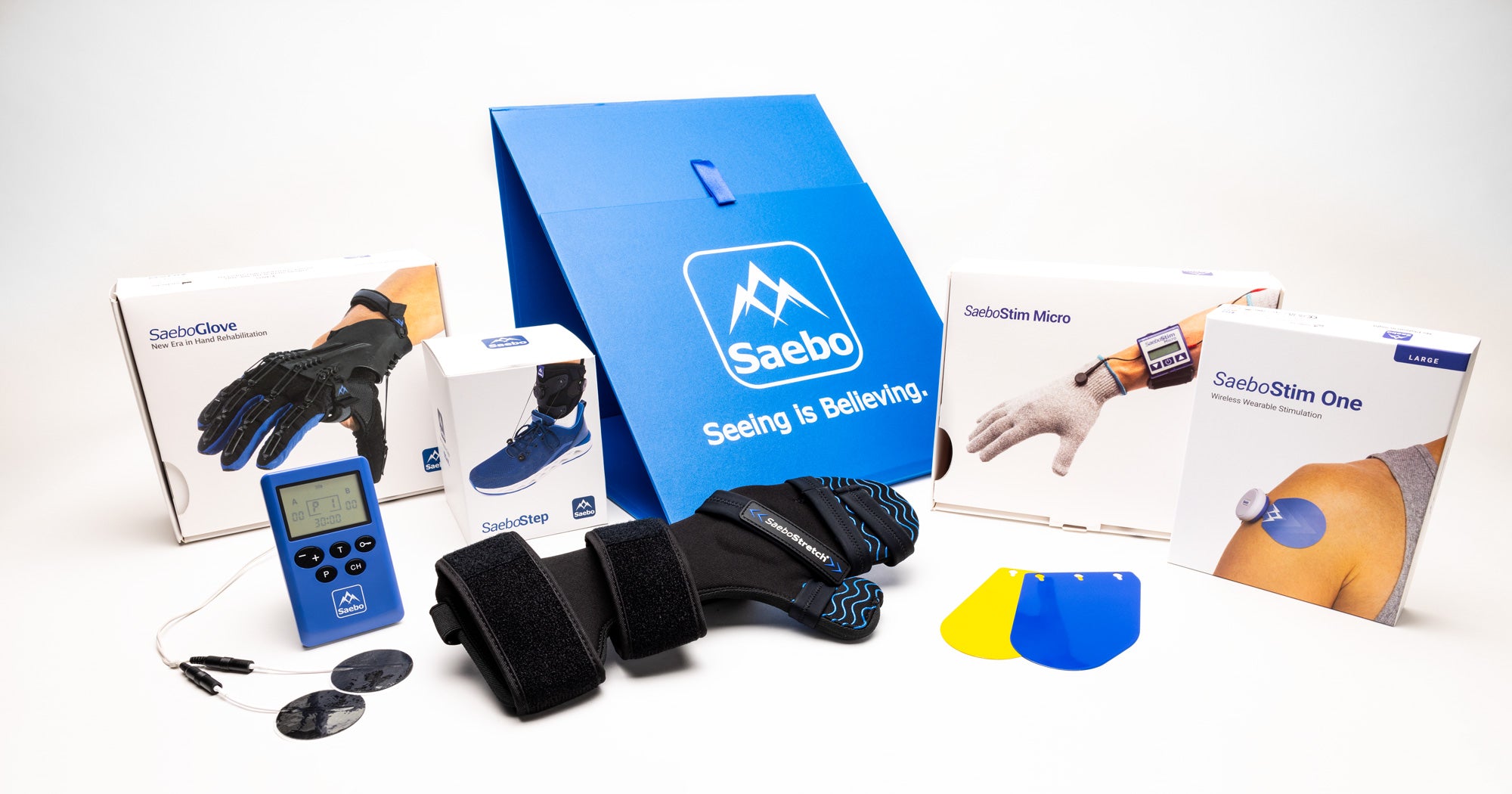
When combined with active, consistent exercises, these stimulation methods enhance brain–muscle communication and promote meaningful recovery even years after stroke. Devices like the SaeboStim Pro combine multiple therapies in one unit, supporting high-repetition exercises that reinforce remapping and improve daily function.
3. Mirror therapy and mental imagery
Mirror therapy uses visual feedback to “trick” the brain into seeing movement in the affected limb. When a mirror reflects the moving, healthy limb, the brain interprets it as the weaker limb moving successfully. This visual illusion activates motor networks and helps the brain rebuild connections controlling the affected side.
Similarly, mental imagery—or visualizing specific movements without performing them—activates similar brain regions as physical practice. When combined with regular exercises, both mirror therapy and mental practice reinforce motor learning and recovery, even in the chronic stage.
4. Saebo devices to support repetition
Saebo devices including SaeboGlove, SaeboFlex, and SaeboGlide, assist stroke survivors with repetitive, functional movements, enhancing neuroplasticity and promoting independence. In addition to supporting the effects of treatment, they also can enable more daily independence by simply providing support. Some examples include:
- SaeboGlove assists with finger and thumb extension for hand exercises.
- SaeboFlex supports grasp-and-release activities to restore hand use.
- SaeboGlide promotes arm movements in different directions, encouraging active participation.
These tools allow patients to safely perform high-repetition stroke rehab exercises, strengthening motor pathways, reducing stiffness, and improving daily function.
Conclusion
Stroke recovery is possible at any stage, and the brain’s ability to form new neural pathways continues throughout life, offering hope for those in chronic recovery. The brain’s ability to form new neural pathways continues throughout life, offering real hope for those in chronic recovery. While early therapy is beneficial, consistent, evidence-based stroke rehab exercises can lead to meaningful improvements months or even years after injury. Motor-based exercises like Constraint-Induced Movement Therapy and repetitive task training, along with cognitive activities such as word retrieval and memory practice, all strengthen brain networks that support recovery.
Modern tools, including virtual reality, electrical stimulation therapies, and Saebo devices, enhance stroke rehab exercises by providing repeated, engagement, and functional feedback for long-term recovery. Science is clear: neuroplasticity never stops. With patience, variety, and ongoing effort, the brain can continue to adapt, relearn, and restore function well into the chronic stages of stroke recovery.
All content provided on this blog is for informational purposes only and is not intended to be a substitute for professional medical advice, diagnosis, or treatment. Always seek the advice of your physician or other qualified health providers with any questions you may have regarding a medical condition. If you think you may have a medical emergency, call your doctor or 911 immediately. Reliance on any information provided by the Saebo website is solely at your own risk.
