
Shoulder Pain After Stroke: Expert-Backed Exercises to Reduce Subluxation and Improve Arm Recovery

Shoulder pain after stroke, along with weakness and limited arm movement, is one of the most common complications survivors face and can significantly affect daily activities and independence. Many survivors struggle to use their affected arm safely and confidently, which can slow overall recovery and increase frustration. Hemiplegic shoulder pain refers to shoulder pain and instability that develops on the affected side after a stroke, often due to muscle weakness, subluxation, spasticity, or poor joint alignment.
The correct shoulder exercises can reduce post-stroke shoulder pain, improve joint stability, prevent subluxation, and help retrain the brain through repeated, purposeful movement at home or in therapy. Because the brain learns best from consistent practice, targeted shoulder and arm exercises are essential for regaining function. This article covers physical therapist–recommended shoulder stability and arm exercises designed to support safer, more effective, and pain-free recovery after stroke.
Why Shoulder Pain and Instability Happen After Stroke
Shoulder pain is one of the most common and frustrating complications after stroke. Understanding why it develops helps patients and therapists choose the right interventions and apply shoulder exercises safely and effectively during recovery.
Common causes: subluxation, spasticity, and immobility
Shoulder subluxation after stroke, a partial dislocation of the shoulder joint, may affect up to 80% of stroke survivors, particularly during the early flaccid stage of recovery [1]. This condition occurs when the upper arm bone (humeral head) partially separates from the shoulder socket, leading to joint instability, pain, and reduced arm function. Subluxation most often develops within the first few weeks after stroke, when muscle weakness and poor postural control are most pronounced.
Immediately following a stroke, muscles on the affected side frequently become flaccid, meaning they lack normal strength and tone. These weakened muscles are unable to adequately support the humeral head within the glenoid cavity. As a result, gravity causes the arm to pull downward, stretching the joint capsule, ligaments, and surrounding soft tissues. Improper positioning during transfers, unsupported sitting, or prolonged arm dangling can further increase stress on the shoulder joint, worsen subluxation, and increase the risk of long-term hemiplegic shoulder pain.
As recovery progresses, many individuals transition from flaccidity to spasticity, characterized by involuntary muscle tightness and reduced flexibility. Muscles such as the pectoralis major, latissimus dorsi, and rhomboids may become overactive, pulling the shoulder and scapula into abnormal positions. This altered muscle balance disrupts normal scapular movement and can increase downward rotation of the shoulder blade, further compromising joint alignment. Longitudinal research suggests that without appropriate intervention, shoulder stability often declines over time, increasing the risk of chronic pain, frozen shoulder (adhesive capsulitis), and long-term arm dysfunction.
How stroke affects shoulder muscles and nerves
The shoulder joint is built for mobility rather than stability, relying more on coordinated muscle activity than bone structure for support. After a stroke, damage to the brain areas that control movement disrupts this coordination, weakening key stabilizing muscles such as the supraspinatus and posterior deltoid.
During the flaccid stage, individuals often lean toward the affected side due to weakness and poor postural control. This causes the shoulder blade (scapula) to drop from its normal position. Weakness in the trapezius and serratus anterior contributes to abnormal scapular alignment, limiting the rotator cuff’s ability to stabilize the joint and increasing the risk of shoulder instability.
As joint alignment is compromised, excessive traction and altered mechanics place stress on surrounding nerves and soft tissues. This can result in aching, burning, or radiating pain in the shoulder and upper arm. Shoulder pain may begin within the first few weeks after stroke and often worsens over the next two to three months if underlying instability is not addressed.
The role of learned disuse in long-term dysfunction
Survivors often worsen shoulder dysfunction through learned nonuse, unintentionally avoiding their affected arm due to weakness or pain. As a result, they rely almost entirely on their unaffected arm during daily activities.
Over time, muscles on the affected side become progressively weaker, creating a destructive cycle: weakness leads to disuse, which then causes further weakness and potential muscle atrophy. This pattern is especially common in individuals with left-sided neglect, who may have reduced awareness of their affected side.
Without regular use, brain-to-muscle connections continue to weaken, slowing overall stroke arm recovery and making it harder to regain functional movement. However, targeted shoulder strengthening exercises and consistent practice can help reverse this process. Through neuroplasticity, the brain can form new pathways that support improved movement and function.
How Shoulder Exercises Support Recovery
The science behind shoulder rehabilitation shows how targeted exercises are crucial after stroke. Well-designed exercises strengthen muscles and help rewire your brain to support lasting recovery.
Understanding neuroplasticity and motor relearning
After a stroke, the brain has a remarkable ability to reorganize itself through neuroplasticity, creating new neural connections that support arm and shoulder recovery. Scientists once thought the brain was fixed, but now we know it remains adaptable throughout life, forming alternative pathways around damaged areas. This adaptation occurs through new neuronal connections, changes in synaptic strength, and cortical map reorganization.
Stroke survivors with shoulder weakness can help their brains gradually relearn muscle control by establishing these new pathways. Motor relearning allows healthy brain regions to take over functions from damaged areas. Recovery starts with the unaffected hemisphere and gradually involves learning-related structures like the cerebellum and frontal cortices.
Why repetition and consistency matter
Repetition drives neuroplasticity. Each practiced shoulder movement strengthens the neural connections linked to that action. Like making a path through a forest, initial attempts feel awkward, but the path becomes clearer and easier with use.
Research shows that hundreds of daily repetitions, whether performed in therapy or through structured stroke exercises at home, create meaningful brain changes. A Cochrane review found that repetitive task training improves arm function, hand function, and overall mobility, with benefits lasting up to six months after treatment [2].
The most significant recovery occurs in the first three months, but steady practice can continue to produce improvements over several years. Many survivors ask how long shoulder pain lasts after a stroke; while timelines vary, early intervention and consistent shoulder rehabilitation significantly reduce the risk of chronic pain.
Starting shoulder rehab after stroke
Early rehabilitation produces the best outcomes. Experts recommend starting within 24–48 hours after stroke [3]. In many clinics or hospitals, rehabilitation often begins while patients are still in the hospital, sometimes as soon as four hours after stroke onset.
Delaying rehabilitation can cause muscle weakness, joint stiffness, and worsening side differences. The brain responds best during acute and subacute stages. Starting early is important, but steady practice can continue to produce improvements over several years.
How to Prevent Shoulder Pain and Subluxation After Stroke
Early prevention is critical during the flaccid stage of stroke recovery. Proper arm positioning, supported sitting, and avoiding arm pulling during transfers can reduce strain on the shoulder joint. Gentle weight-bearing and early activation of the deltoid and scapular stabilizers may help maintain alignment and reduce the risk of hemiplegic shoulder pain.
5 Expert-Backed Shoulder Exercises to Reduce Shoulder Pain After Stroke
Recovering shoulder function after a stroke requires exercises that address specific challenges. These five exercises form a strong foundation for a rehabilitation program.
Weight-Bearing Arm Support on Table or Counter
Placing your affected arm on a table or counter and slowly applying weight helps your brain sense where your arm is, your body’s “internal GPS.” Adding weight to the weaker side activates more muscles, increasing strength and function. Doing this regularly can reduce stiffness, improve muscle tone, prevent shoulder subluxation from worsening, and help your brain rewire itself for better arm control. For added benefit, practicing intentionally stabilizing your muscle with shoulder blade squeezes can further the benefit. You can do this by leaning onto an elbow, putting your hands down on a table, or even by being on your hands and knees.
Shoulder Flexion and Abduction
These exercises improve shoulder mobility, strengthen muscles, and help prevent stiffness after stroke.
- Flexion: Sit or lie on your back (supine). Slowly lift your affected arm straight in front of you as high as comfortable, then lower it back down. Keeping your elbow slightly bent can make it easier.
- Abduction: Lift your arm out to the side, away from your body, then slowly lower it.
Supine Dowel Exercises:
Lying on your back, hold a lightweight dowel (or broomstick) with both hands. Use your unaffected arm to gently guide the affected arm through flexion (lifting forward) or abduction (lifting to the side). This support helps you move the arm safely while reducing strain, letting your shoulder muscles gradually activate.
SaeboGlide Option:
The SaeboGlide, developed by Saebo to support stroke arm rehabilitation, is a guided support device that reduces strain during shoulder flexion and abduction while promoting proper joint alignment. It allows you to perform flexion and abduction exercises with less effort and better control, which helps build strength and improve range of motion safely. Using it regularly reinforces brain-muscle communication, supports safer early-stage shoulder recovery, and may reduce the risk of hemiplegic shoulder pain when combined with therapeutic exercise.
Perform these exercises in slow, controlled movements. Focus on smooth motion without forcing your arm and stop if you feel sharp pain. These movements can help you regain function for daily activities like reaching overhead, lifting objects, or brushing your hair.
Supported Reaching with SaeboMAS
Reaching is essential for daily activities like eating, dressing, and grabbing objects, but shoulder weakness and subluxation often make it difficult after stroke. A mobile arm support can reduce the effects of gravity and allow safer, higher-repetition practice.
The SaeboMAS (Mobile Arm Support) helps offload the weight of the arm while allowing active forward and upward reaching. By supporting the shoulder during movement, it reduces strain, limits compensatory shoulder hiking, and encourages more normal motor patterns.
To practice supported reaching:
- Sit upright with your feet flat.
- Position your affected arm in the SaeboMAS.
- Slowly reach forward toward a target.
- Return with control and repeat.
Consistent, task-specific reaching practice promotes neuroplasticity, improves shoulder stability, and supports functional arm recovery after stroke.
Scapular Retraction and periscapular
Your shoulder blades (scapula) are important for posture, stability, and daily movements. There are several movements your shoulder blades do, but retraction is among the most vital. To do scapular retraction:
- Sit tall with your feet flat.
- Gently squeeze your shoulder blades together without raising your shoulders.
- Hold 2–3 seconds, then relax.
Other periscapular exercises may include gentle arm circles or shoulder blade “push-downs,” focusing on controlled, pain-free movement. Strengthening these muscles reduces shoulder pain, improves trunk control, and supports easier use of your arm in daily activities.
Deltoid strengthening with electrical stimulation
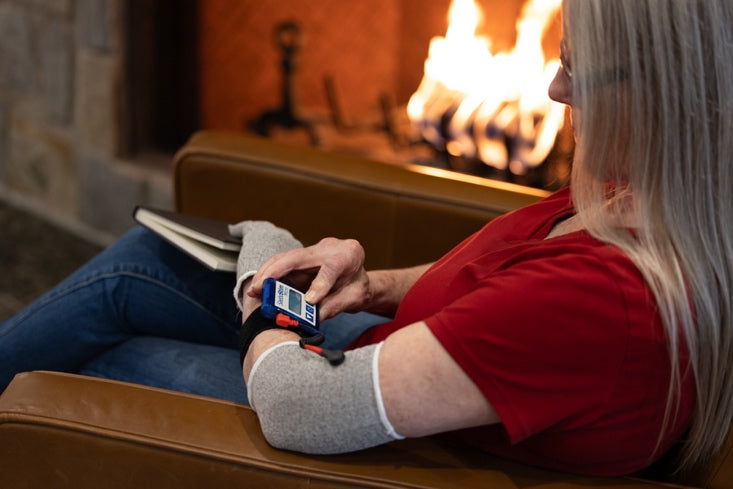
Neuromuscular electrical stimulation (NMES) can help support the shoulder when muscles are too weak to stabilize the joint independently after stroke. The SaeboStim One, a wearable NMES device from Saebo, targets the deltoid muscle, which plays a critical role in reducing shoulder subluxation after stroke. The deltoid helps lift the arm bone upward into the shoulder socket, counteracting gravity. In stroke recovery, the deltoid is often a better focus than the smaller rotator cuff muscles because it is easier to activate and provides stronger support early on.
With SaeboStim One, electrodes are placed over the deltoid to create gentle muscle contractions. Sessions typically last 20–30 minutes and work best when combined with movement. Starting electrical stimulation early in the acute or subacute stage produces the strongest results, but NMES can still improve shoulder alignment and arm recovery even in the chronic stage after stroke.
Exercises to Pair with Stimulation
- Supported shoulder flexion (lifting the arm forward)
- Supported shoulder abduction (lifting the arm to the side)
- Gentle weight-bearing through the arm
Used alongside daily therapy, electrical stimulation can improve shoulder alignment, strength, and reduce complications.
Tips for Safe and Effective Practice at Home
Practicing shoulder exercises at home requires good form and attention to safety. Proper movement patterns help prevent shoulder pain complications, frozen shoulder, and setbacks during stroke recovery.
Avoiding shoulder hiking and poor posture
Lifting the shoulder toward the ear is a common mistake during rehabilitation. While it may look like progress, it prevents the correct muscles from working. Placing your unaffected hand on the affected shoulder can help remind you to keep it relaxed and down.
Using mirrors or caregiver feedback
Mirrors can improve exercise accuracy. Setting up a mirror allows you to watch your movements and correct poor patterns. This feedback is especially helpful if you have cognitive changes after stroke. A caregiver or therapist can help you get positioned correctly when first learning the exercises.
How to know when to stop or modify an exercise
Pain is a warning sign. Exercises should not cause burning, sharp, or shooting sensations. Stop immediately if pain occurs and modify by reducing the range of motion, using less resistance, or consulting your therapist. Taking breaks helps prevent fatigue-related movement errors.
Conclusion
Recovering from stroke-related shoulder problems takes patience and persistence. Shoulder rehabilitation is a critical part of stroke recovery, helping address hemiplegic shoulder pain, subluxation, weakness, and limited arm movement.
These exercises work because they tap into neuroplasticity, the brain’s ability to form new connections. Consistency is essential, each repetition strengthens brain-muscle communication and supports long-term improvement.
Progress may feel slow at first, but small gains add up. Starting with simple, well-controlled movements builds a stronger foundation than pushing through poor form or compensations. With the right stimulation and proper technique, the brain can continue adapting even years after a stroke.
Safe practice matters. Using mirrors, caregiver support, and therapist guidance helps ensure exercises are helpful and pain-free. With regular practice, proper positioning, and when appropriate, supportive tools like Saebo’s rehabilitation devices, these expert-backed exercises can steadily improve strength, stability, and long-term arm function—reducing shoulder pain after stroke and restoring independence.
Frequently Asked Questions About Shoulder Pain After Stroke
How long does shoulder pain last after a stroke?
Shoulder pain may begin within weeks after stroke and can last several months if not addressed early. With proper positioning, strengthening, and neuromuscular retraining, many individuals experience significant improvement within the first three to six months.
Can shoulder subluxation after stroke be reversed?
Mild shoulder subluxation can improve with early stabilization exercises, weight-bearing, and in some cases neuromuscular electrical stimulation. While full reversal depends on severity, consistent rehabilitation can significantly reduce instability and pain.
Should I wear a sling for shoulder subluxation?
Slings may provide short-term protection during early flaccid stages, but prolonged use can contribute to stiffness and learned nonuse. Active rehabilitation and guided support are typically more beneficial long term.
What is the best treatment for hemiplegic shoulder pain?
The most effective treatment combines proper positioning, scapular stabilization, strengthening exercises, and when appropriate, electrical stimulation to support joint alignment and muscle activation.
References
All content provided on this blog is for informational purposes only and is not intended to be a substitute for professional medical advice, diagnosis, or treatment. Always seek the advice of your physician or other qualified health providers with any questions you may have regarding a medical condition. If you think you may have a medical emergency, call your doctor or 911 immediately. Reliance on any information provided by the Saebo website is solely at your own risk.
