
Stroke Arm and Hand Recovery: 10 Proven Rehabilitation Techniques (Free Upper Limb Guide)

Each year, tens of thousands of people in North America alone experience a stroke or transient ischemic attack, often resulting in arm and hand weakness after stroke that affects daily life and independence. Regaining upper limb function after stroke is often more challenging than recovering lower limb movement, and only about half of stroke survivors who initially have a paralyzed upper limb regain useful function within six months.
Effective upper limb rehabilitation requires evidence-based, targeted strategies. Patients benefit most from approaches that are tailored to their abilities, encourage repetition, and focus on meaningful, real-world tasks. Even small, consistent improvements like opening and closing the hand hundreds of times can drive lasting changes in the brain, reinforcing the neural pathways needed for functional movement. For many stroke survivors and caregivers searching for how to improve arm movement after stroke, understanding which rehabilitation strategies actually work is the first step toward recovery.
In this blog, we provide a high-level overview of 10 proven strategies to support upper limb recovery. Saebo’s free Upper Limb Recovery Guide shows exactly how to apply evidence-based treatments, including electrical stimulation, task-specific training, high-repetition practice, mirror therapy, mental practice, constraint-induced movement therapy (CIMT), aerobic exercise, spasticity management, resistance training, and goal setting. This blog will specifically review some top tips, such as repetition, task-specific training, and electrical stimulation.
Understanding upper limb stroke rehabilitation
Stroke survivors face many obstacles during upper limb stroke recovery, particularly when rebuilding strength, coordination, and functional use of the affected arm and hand. Each person's recovery path looks different, and upper limb function remains one of the toughest challenges to overcome. Learning about these challenges helps develop treatment strategies that make a real difference in recovery outcomes.
How to Improve Arm and Hand Recovery After Stroke
Stroke arm recovery depends on activating neuroplasticity through repetition, task-specific training, and consistent practice. While every recovery journey is different, research shows that targeted upper extremity stroke rehabilitation exercises, even when performed at home, can lead to meaningful improvements months or even years after a stroke.
Common challenges after stroke
Upper limb impairment after stroke affects as many as 80% of stroke survivors and is a leading cause of long-term disability, often limiting independence with daily activities such as dressing, eating, and grooming [1]. Even six months after a stroke, about 50% or more still struggle to use their affected arm during everyday tasks [2]. Many who experience neurological improvement continue to notice subtle hand use difficulties, especially during more complex movements.
Common post-stroke challenges include:
- Muscle tone changes: Muscles may start out weak or heavy, then become tight or shortened over time, making movement difficult.
- Shoulder complications: Reduced muscle support can lead to shoulder subluxation, a partial dislocation that requires careful management.
- Pain and swelling: Stiffness, swelling, and discomfort in the shoulder, hand, or wrist are frequent barriers to recovery.
- Spasticity: Many stroke survivors develop spasticity, which often affects the arm more than the leg.
- Sensory loss: Decreased sensation disrupts motor control and makes fine motor tasks harder.
- Learned non-use: Avoiding the affected arm due to difficulty or frustration can further slow stroke arm recovery without targeted intervention.
Alongside these physical challenges, many stroke survivors also face psychosocial barriers. Understanding these challenges helps explain why targeted, evidence-based treatments are critical for restoring upper limb function. Access to resources, the quality of patient–clinician relationships, and emotional well-being all influence how effectively someone can participate in upper limb rehabilitation.
The role of neuroplasticity in upper limb recovery
Neuroplasticity after stroke is the foundation of recovery and brings hope even when progress feels slow or stalled. Your brain can reorganize itself and create new neural connections when faced with damage, learning experiences, and environmental changes. Knowing how neuroplasticity works can change your approach to upper limb rehabilitation after stroke. This ability to rewire the brain explains why arm function can continue to improve long after a stroke, even during the chronic recovery phase.
How the brain rewires after stroke
The brain is highly adaptable. After stroke, it reorganizes by forming new connections, strengthening existing pathways, and recruiting additional brain regions to support movement. Both the injured and uninjured hemispheres show increased activity as the brain works to restore arm and hand function.
Recovery involves several processes:
- Local and network reorganization as nearby and distant brain areas compensate
- Changes in communication between hemispheres
- Remapping of sensory and motor areas
Research shows that when newly recruited brain regions are disrupted, recovered movement temporarily disappears which is proof that these rewired networks are essential for functional gains.
How to advance neuroplasticity
Neuroplasticity is activated when the brain is challenged with meaningful, repeated, and goal-directed activity. Repetition strengthens the neural pathways needed for movement, especially when paired with functional stroke arm exercises such as reaching, grasping, releasing, and stabilizing objects. For example, repeatedly practicing picking up a cup, sliding the hand across a table, or opening and closing the fingers provides the brain with task-specific feedback that accelerates recovery.
Intensity and consistency are also key. High volumes of practice, often hundreds of repetitions a day, combined with steady, ongoing training help the brain refine and maintain new movement patterns. The brain responds even more when practice includes sensory input, attention, and problem-solving, rather than passive movement.
These principles are the foundation of many evidence-based treatments. Techniques like electrical stimulation, mirror therapy, mental practice, CIMT, and task-oriented training each leverage these neuroplasticity triggers in different ways, setting the stage for meaningful upper limb recovery.
Why arm recovery is often slower than leg recovery
Stroke arm recovery is often slower than leg recovery because the hand and arm require more precise, coordinated movements and sensory feedback. Rehabilitation priorities also contribute whereas early therapy typically focuses on mobility, leaving less time for arm and hand training. Importantly, slower progress does not mean recovery is no longer possible, continued upper extremity stroke therapy can still produce gains well beyond the early stages.
Biological factors add to the challenge. Spasticity and pain in the shoulder, elbow, and wrist can limit dexterity and slow progress. As a result, upper limb function improves less often than lower limb function, even though daily independence depends on using both hands. Recognizing these barriers is essential for developing effective upper limb rehabilitation strategies.
Top Stroke Rehabilitation Strategies for Arm and Hand Recovery
Recovering affected arm function after a stroke can feel overwhelming, especially for individuals searching for effective stroke rehabilitation exercises that fit into daily life. Stroke survivors often face challenges such as weakness, spasticity, and limited mobility in the affected upper limb, which can impact independence and quality of life. The path to recovery is unique for everyone, but research shows that a targeted, consistent approach can significantly improve outcomes.
That is why Saebo developed a complete Upper Limb Recovery Guide. In our comprehensive guide, we highlight 10 key strategies for upper limb recovery. These strategies are grounded in clinical evidence and include approaches that will maximize the brain’s ability to rewire to support long-term, meaningful recovery. Here are some top tips.
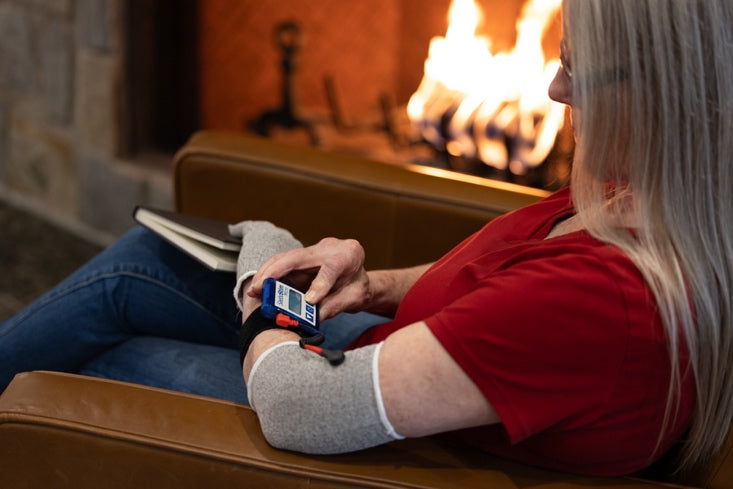
Electrical stimulation for Stroke Arm Recovery (NMES & FES)
After a stroke, the brain’s connection to muscles can be disrupted, making it difficult to move the hand even when the muscles themselves are healthy. Electrical stimulation (E-Stim) is a rehabilitation tool that helps “retrain” this connection. By sending small, controlled electrical pulses to targeted muscles, E-Stim prompts the muscle to contract, creating movement even when voluntary control is limited.
This process is more than just moving a muscle, it plays a key role in neuroplasticity, the brain’s ability to rewire itself. When the muscle responds to stimulation, sensory feedback is sent back to the brain, reinforcing the neural pathways that control movement. In other words, E-Stim helps close the loop: the brain sends a signal, the muscle fires, and the resulting feedback strengthens the brain-muscle connection. Over time, this can improve voluntary control, coordination, and functional movement.
E-Stim is often combined with task-specific practice, repetition, and other evidence-based strategies to maximize recovery. It empowers stroke survivors to actively engage in their rehabilitation, giving the brain the feedback it needs to “remember” how to move the affected limb. Saebo’s clinical team frequently incorporates neuromuscular electrical stimulation (NMES) into upper limb stroke rehabilitation programs to help restore voluntary movement and improve functional outcomes.
Task-specific training
Task-specific training helps stroke survivors regain function by practicing real-life stroke arm recovery exercises, many of which can be performed safely at home. This approach supports neuroplasticity by giving the brain repeated, purposeful experiences that reinforce the connection between thought and movement. Every time a patient practices a meaningful task, the brain gets feedback from the muscles and joints, strengthening the pathways needed to perform that task independently. Gradually increasing the difficulty of these activities challenges the brain, encouraging it to adapt and “rewire” itself for better control and coordination.
Unlike exercises that focus on single movements, task-specific training teaches the brain and body to work together in context, helping stroke survivors rebuild the skills that matter most in daily life. Examples include reaching to different shelf heights, stabilizing an object with the affected hand, or practicing buttoning with adaptive positioning.
Repetition: The Engine of Stroke Arm and Hand Recovery
When it comes to regaining arm and hand function after a stroke, practice truly matters. It’s not just about how long therapy sessions last, it’s about how much your brain and muscles are actively working together. Repetition is the key to strengthening the connections between your brain and your muscles, helping the nervous system “rewire” itself and restore movement.
The more you repeat meaningful movements, the stronger those neural pathways become. Even small improvements build on themselves over time, turning effort into lasting progress. To make repetition effective:
- Aim for high repetition counts. Research suggests that 100–300 repetitions of stroke arm exercises per session can drive stronger neuroplastic changes than lower-dose practice [3]. This is why short, frequent practice sessions often outperform longer, less consistent therapy visits.
- Practice meaningful, real-life tasks. Reaching for a cup, brushing your teeth, or opening a door helps the brain link movement with purpose, making progress functional and relevant.
- Gradually increase the challenge. Push just enough to be difficult but not frustrating. The right challenge strengthens the brain-muscle connection faster.
- Vary your practice. Mixing tasks and conditions keeps the brain engaged and adaptable, which encourages more flexible motor learning.
- Use clear, goal-oriented feedback. Simple instructions like “repeat this movement 25 times as quickly as you can” can boost motivation and increase the number of effective repetitions.
Repetition isn’t just busywork; it’s the engine that drives recovery. By combining high-repetition practice with strategies like electrical stimulation and task-specific training, stroke survivors can maximize neuroplasticity and make meaningful gains, even months or years after a stroke.
Get your complete Upper Limb Recovery Guide
At Saebo, we are committed to supporting stroke survivors, caregivers, and clinicians with evidence-based stroke rehabilitation tools and education that make upper limb recovery more accessible, effective, and hopeful. Whether you are just beginning your recovery journey or looking to enhance an existing program, these evidence-based strategies provide a roadmap to regain independence and improve function. In addition to the above-mentioned treatment approaches, our comprehensive guide also includes mirror therapy, mental practice, constraint-induced movement therapy (CIMT), aerobic exercise, spasticity management, resistance training, and goal setting. While this blog offers a high-level preview, the full guide provides step-by-step instructions for incorporating each technique into a recovery plan.
By combining high-repetition practice, task-specific training, and proven technologies, stroke survivors can take an active role in improving arm and hand function at any stage of recovery.
References
All content provided on this blog is for informational purposes only and is not intended to be a substitute for professional medical advice, diagnosis, or treatment. Always seek the advice of your physician or other qualified health providers with any questions you may have regarding a medical condition. If you think you may have a medical emergency, call your doctor or 911 immediately. Reliance on any information provided by the Saebo website is solely at your own risk.
