
How Many Repetitions Are Needed for Stroke Recovery? Why Repetition Matters More Than Therapy Time
Research reveals a troubling reality: stroke patients often receive less than 8 minutes of daily task-specific upper limb therapy, far below what is required for meaningful arm and hand recovery after stroke [1]. The average therapy session delivers only about 30 functional repetitions, but in reality, 300–400 task-specific repetitions per session may be required to stimulate meaningful neuroplasticity after stroke. The gap between current practice and what science demands is huge.
We've built this piece around a core thesis: repetition in therapy drives brain recovery better than session length does. The brain responds to high-volume, task-specific practice, not just time spent in therapy. The number of meaningful movements performed is what truly drives rehabilitation intensity after stroke. We'll demonstrate why volume matters most for functional recovery by dissecting the neuroscience and comparing time-based versus repetition-based approaches. We'll also share practical strategies to increase rep counts.
The Science Behind Repetition: Why Reps Drive Neuroplasticity More Than Time
Task-specific stroke recovery exercises create real changes in the brain when movements are repeated at high volume. With consistent practice, the brain strengthens existing pathways and builds new connections, gradually improving control of the affected arm and hand.
Research on intensive motor training shows that recovery improves when individuals perform hundreds of functional repetitions per day — often in the range of 400–600 movements [2]. In human studies, survivors who completed more than 1,000 structured training trials, totaling thousands of finger movements, showed activation in brain areas that had been quiet after the stroke. The takeaway is simple: the brain adapts when it is challenged with enough meaningful repetition.
This is why repetition matters more than scheduled time. A 30-minute therapy session can include anywhere from just a handful of movements to several hundred. Tracking minutes alone doesn’t reflect the true rehabilitation dose — because recovery depends on how many quality repetitions are performed.
And not all reps are equal. Repetitions that are goal-driven, successful, and progressively challenging strengthen the brain even more, helping reinforce lasting motor improvements.
How Many Repetitions Are Needed for Stroke Recovery?
Most stroke survivors with mild-to-moderate impairment may benefit from 300–400 meaningful, task-specific repetitions per session, while some studies suggest recovery can improve with up to 600 repetitions per day, depending on fatigue and functional capacity. While the exact number varies depending on stroke severity and recovery stage, consistently low repetition counts are often linked to stalled or plateaued progress.
Time-Based Therapy vs Repetition-Based Training: Understanding the Critical Difference
Stroke rehabilitation guidelines around the world still measure therapy by minutes. While this seems straightforward, it hides an important issue: most studies track how long therapy lasts, not how many meaningful stroke recovery exercises are performed during that time.
When researchers look closer at actual movement practice, the numbers are often surprisingly low. One study found that only about 34% of therapy time involves task-specific practice [3]. In certain inpatient settings, patients complete anywhere from 4 to 369 repetitions in a 30-minute session — illustrating how variable and often insufficient practice volume can be.
This helps explain why simply adding a few extra minutes of therapy doesn’t always lead to better results. Research reviews show that small increases in therapy time often produce little change in daily function. Recovery appears to depend less on how long therapy lasts and more on how many quality, task-specific repetitions are performed.
In many cases, we’ve been measuring the wrong thing — focusing on therapy time instead of repetition volume.
High-Repetition Stroke Recovery Exercises for the Arm and Hand
Examples of task-specific, high-repetition stroke exercises include:
- Reaching to grasp cones or cups and placing them on a shelf
- Repetitive grasp-and-release of therapy blocks
- Towel slides on a table to practice shoulder flexion
- Finger tapping or sequential finger opposition drills
- Object transfer tasks (moving coins, pegs, or small household items)
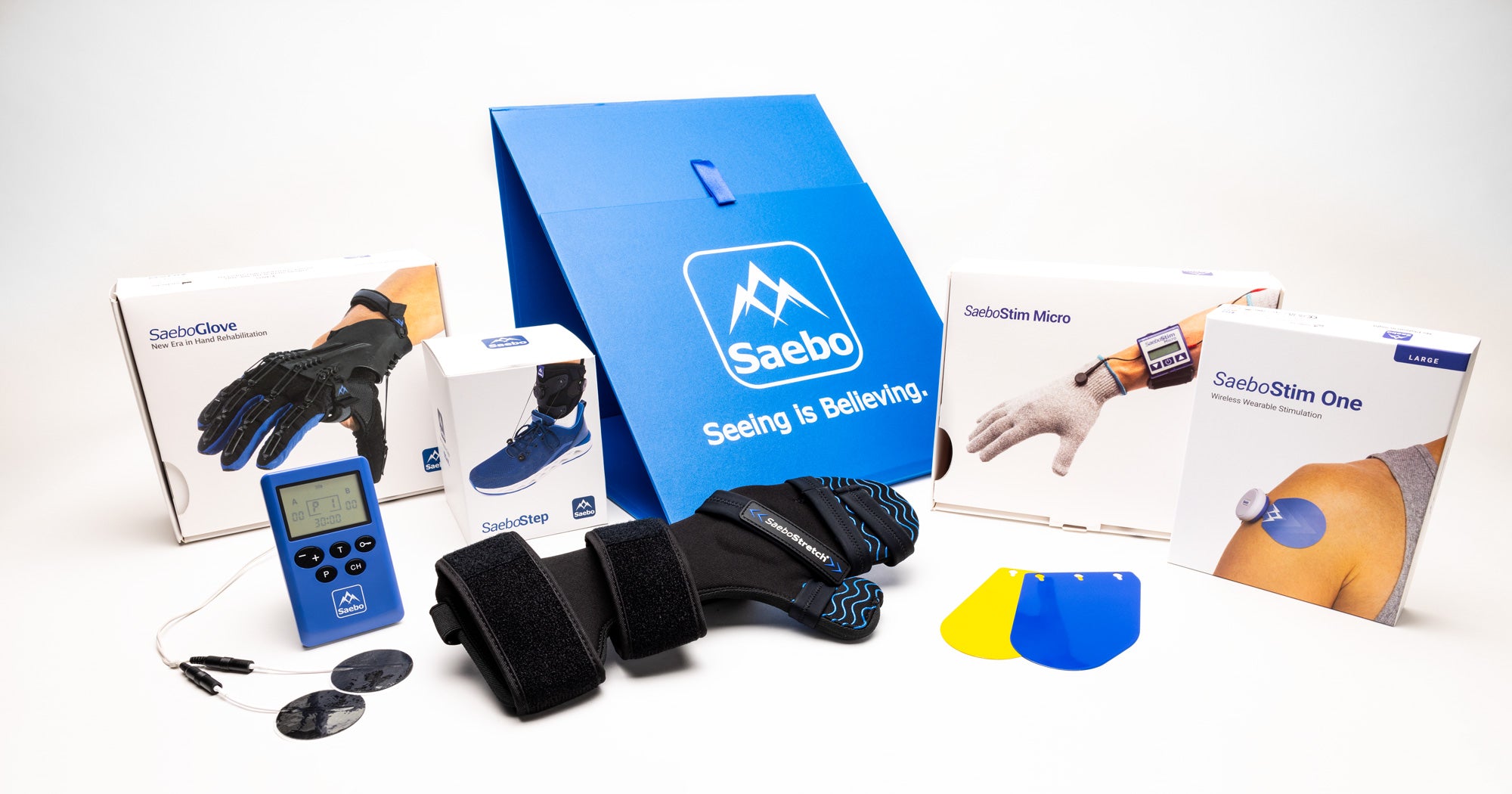
For individuals with limited finger extension, devices such as the SaeboFlex or SaeboGlove can assist with hand opening, allowing patients to safely complete hundreds of grasp-and-release repetitions per session. Arm support systems like the SaeboMAS reduce the effects of gravity, enabling greater repetition volume without excessive fatigue.
Practical Strategies to Increase Repetitions Without Extending Session Length
Extending therapy time isn’t always necessary to boost recovery. Often, increasing the number of meaningful movements within existing sessions is enough. Here are simple ways to increase repetition during stroke rehabilitation:
1. Set Clear Rep Goals
Instead of casually practicing a movement, decide on a number. For example:
“Reach and grasp this cup 25 times.”
Tracking reps — and trying to beat your previous total — naturally increases effort and focus without adding extra minutes.
2. Reduce Downtime Between Reps
Limit long rest breaks, unnecessary repositioning, or distractions. Small pauses add up. Staying focused on continuous movement can dramatically increase total repetitions.
3. Practice Functional Tasks Repeatedly
Choose meaningful movements like:
- Reaching and placing objects on a shelf
- Grasping and releasing household items
- Repeated sit-to-stand practice
- Step training or supported walking
The more task-specific the movement, the more beneficial each repetition becomes.
4. Use Tools That Enable More Movement
If weakness limits how many reps you can perform, assistive devices can help you practice more safely and efficiently. For example:
- The SaeboFlex or SaeboGlove can assist with hand opening to allow repeated grasp-and-release practice.
- The SaeboMAS supports the arm against gravity, helping you perform more reaching repetitions without excessive fatigue.
The goal isn’t assistance for convenience — it’s assistance that allows more practice.
5. Turn Home Practice into Structured Sets
Instead of doing a few exercises casually, organize home therapy into sets:
- 3 sets of 20 reaches
- 2 sets of 25 grasp-and-release drills
- 5 minutes of continuous step training
Structured sets help you hit higher repetition targets without extending your total practice time.
6. Make It Measurable
Keep a simple tally. When you track your repetitions, you naturally increase them.
Why Stroke Recovery Plateaus — And How Repetition Breaks It
Many stroke survivors experience a recovery plateau when repetition volume drops below the threshold needed to stimulate ongoing neuroplastic change. Increasing task-specific repetitions — even without increasing session length — can help re-engage cortical networks and promote continued motor improvement.
Conclusion
The evidence suggests we may have been measuring the wrong thing. Recovery isn’t driven by how long therapy lasts — it’s driven by how many meaningful, task-specific repetitions are performed. Instead of asking how many minutes are on the schedule, ask how many quality movements are completed.
Practical strategies such as setting clear repetition goals, minimizing downtime, organizing home exercises into structured sets, and using supportive devices — including Saebo orthotics for assisted grasp and arm training — can significantly increase movement volume without lengthening sessions.
When therapy prioritizes high-volume, purposeful movement, it aligns with how the brain actually rebuilds after stroke. Count repetitions. Challenge the system. Give the brain the practice it needs.
FAQs
Why is repetition so important for stroke recovery?
Repetition helps the brain relearn lost skills. When you practice the same movement over and over — like reaching, grasping, or stepping — the brain strengthens the pathways that control that movement. The more meaningful repetitions you perform, the stronger those pathways become. Recovery improves when the brain gets enough practice.
How many repetitions are needed per session to see meaningful recovery?
Most stroke survivors likely need at least 300–400 meaningful repetitions per session to see noticeable improvement. Some research suggests recovery may benefit from up to 600 repetitions per day, depending on the stage of recovery and level of weakness. In general, more high-quality practice leads to better results.
Why don't traditional 45-minute therapy sessions provide enough repetitions?
A 45-minute session does not automatically mean 45 minutes of movement. Often only about one-third of therapy time involves active, task-specific practice. In some settings, patients complete as few as 4 to 369 repetitions in 30 minutes — far below what the brain likely needs to drive change. Time alone doesn’t guarantee enough movement.
How can I increase repetitions without making therapy sessions longer?
You can increase repetitions by:
- Setting a specific rep goal (for example, 3 sets of 20 reaches)
- Reducing long rest breaks
- Practicing functional tasks repeatedly
- Structuring home exercises into measurable sets
- Using supportive tools, such as Saebo devices, to assist with grasping or arm movement so more repetitions can be completed safely
Small changes in structure can dramatically increase total movement.
Should progress be measured by repetitions completed rather than time spent?
Yes. Tracking how many quality repetitions you perform gives a clearer picture of your true therapy dose. Since the brain responds to repeated movement, counting reps helps ensure you’re doing enough practice to support continued recovery.
References
All content provided on this blog is for informational purposes only and is not intended to be a substitute for professional medical advice, diagnosis, or treatment. Always seek the advice of your physician or other qualified health providers with any questions you may have regarding a medical condition. If you think you may have a medical emergency, call your doctor or 911 immediately. Reliance on any information provided by the Saebo website is solely at your own risk.
