
Stroke Spasticity Exercises: Why Stretching Alone Isn’t Enough and How Saebo Can Help
Spasticity affects a significant portion of all stroke patients, with many of those with survivors continuing to experience it after 12 months (1). Stretching exercises for spasticity become the go-to solution for many survivors. But traditional passive stretching offers only short-term relief and has controversial effectiveness in long-term spasticity management. Modern recovery requires more than lengthening tight muscles. Evidence-based stroke spasticity exercises—including task-specific training, neuromuscular re-education, and hand and arm exercises that promote active movement—help address the neurological root cause while improving functional recovery after stroke. In this piece, we'll explore why stretching alone falls short for how to reduce spasticity in legs and hands, and what actually works: task-specific training, electrical stimulation, and neuromuscular re-education techniques that target both upper and lower extremity spasticity.
What is spasticity and why does it happen?
Spasticity after stroke is a condition where muscles become stiff and overactive due to disrupted communication between the brain and muscles, making movement difficult and sometimes painful. As a result, your muscles become overactive and tight, especially when you try to move them quickly. In simple terms, the faster a muscle is stretched, the more it resists.
This occurs because the brain can no longer properly regulate muscle activity. Normally, the brain sends signals to keep muscle reflexes under control. After an injury, those signals are reduced or lost, causing reflexes to become overactive while voluntary movement becomes harder. This combination of stiffness, weakness, and reduced control is known as upper motor neuron syndrome.
Spasticity can also create a cycle of pain and tightness. When muscles are overly tight, they can become irritated and sensitive, which increases pain. That pain can then make the muscles tighten even more, leading to ongoing discomfort and reduced movement.
Common causes of spasticity (stroke, TBI, spinal cord injury)
Spasticity is most often caused by neurological injuries that affect how the brain communicates with muscles, including stroke, traumatic brain injury, and spinal cord injury. Stroke is one of the most common causes. Many stroke survivors develop spasticity, especially within the first year. It’s more likely to occur after more severe strokes and can vary from mild tightness to significant stiffness that limits movement.
Traumatic brain injury (TBI) can also lead to spasticity. It may appear early after the injury or develop over time, depending on the severity and area of the brain affected. Spinal cord injuries (SCI) frequently result in spasticity as well. Muscle tightness can develop soon after injury and may increase over time, sometimes requiring ongoing management to maintain mobility and comfort.
Other neurological conditions can also cause spasticity. It is very common in individuals with cerebral palsy and multiple sclerosis, often leading to stiffness, muscle spasms, and difficulty with everyday movements.
How spasticity affects daily movement and function
Spasticity interferes with everyday activities such as walking, reaching, and grasping, making simple tasks more difficult after stroke. Moving between surfaces—like getting in and out of a chair or bed—can become especially challenging for people with spasticity. Muscle stiffness and spasms in the legs can interfere with these movements and make mobility more difficult.
Grasping objects, reaching overhead, and managing personal hygiene become challenging when spasticity affects your arms and hands. Leg and foot involvement makes walking difficult and increases fall risk. Specific patterns emerge: clenched fists, bent arms held against the chest, tight knees, and pointed feet.
Spasticity impacts multiple life areas beyond movement limitations. Severe cases can lead to permanent contractures, joint deformities, and pressure ulcers. Reduced functionality and independence affect overall quality of life, with many people experiencing depression, anxiety, and cognitive impairment as secondary complications.
Why stretching alone isn't enough to manage spasticity
Therapists have recommended passive stretching as first-line spasticity treatment for decades. Recent clinical trials challenge this conventional wisdom and reveal significant gaps between anecdotal practice and measurable outcomes (2).
Limitations of passive stretching exercises for spasticity
Studies looking at passive stretching show mixed and modest results. For example, moving the ankle passively in people with spinal cord injuries doesn’t seem to reduce lower‑limb spasticity, especially if the spasticity is mild to begin with. Similarly, hands-on range-of-motion exercises have shown limited benefit, with improvements mostly based on subjective reports and small, non-significant changes on clinical scales.
Short-term relief vs. long-term spasticity management
The benefits of stretching are usually short‑lived. Long passive stretches of 10–30 minutes can reduce spasticity temporarily, but improvements often fade within minutes or hours and sometimes return to baseline within weeks after stopping the stretching. The majority of studies report short-term reductions observed in small sample groups or single-session experiments (2).
Why your muscles need more than just lengthening
Stretching addresses only muscle length without building the stability your body needs for functional movement. Flexibility allows motion, but strength and stability enable you to move without strain. Tight muscles often compensate for instability elsewhere. Your nervous system tightens muscles when it senses weakness. Pain returns soon after stretching. Tightness often returns, and passive stretching alone does not create lasting functional improvements or reduce spasticity long-term; combining stretching with active exercises, task-specific practice, and Saebo-supported hand and finger exercises produces meaningful recovery.
Best Exercises for Stroke Spasticity
The most effective approaches to reducing spasticity after stroke include active movement exercises combined with other therapies such as electrical stimulation, splinting, and medical management when appropriate.
Examples include:
- Hand opening and closing exercises to improve hand spasticity after stroke
- Weight-bearing through the arm to reduce stiffness and improve stability
- Sit-to-stand practice to improve leg spasticity and functional mobility
- Ankle dorsiflexion exercises to improve walking and reduce foot drop
- Reaching and grasping tasks to improve coordination and motor control
Performing these stroke rehabilitation exercises at home consistently can significantly improve mobility and reduce spasticity over time.
The missing link: active movement and neuroplasticity
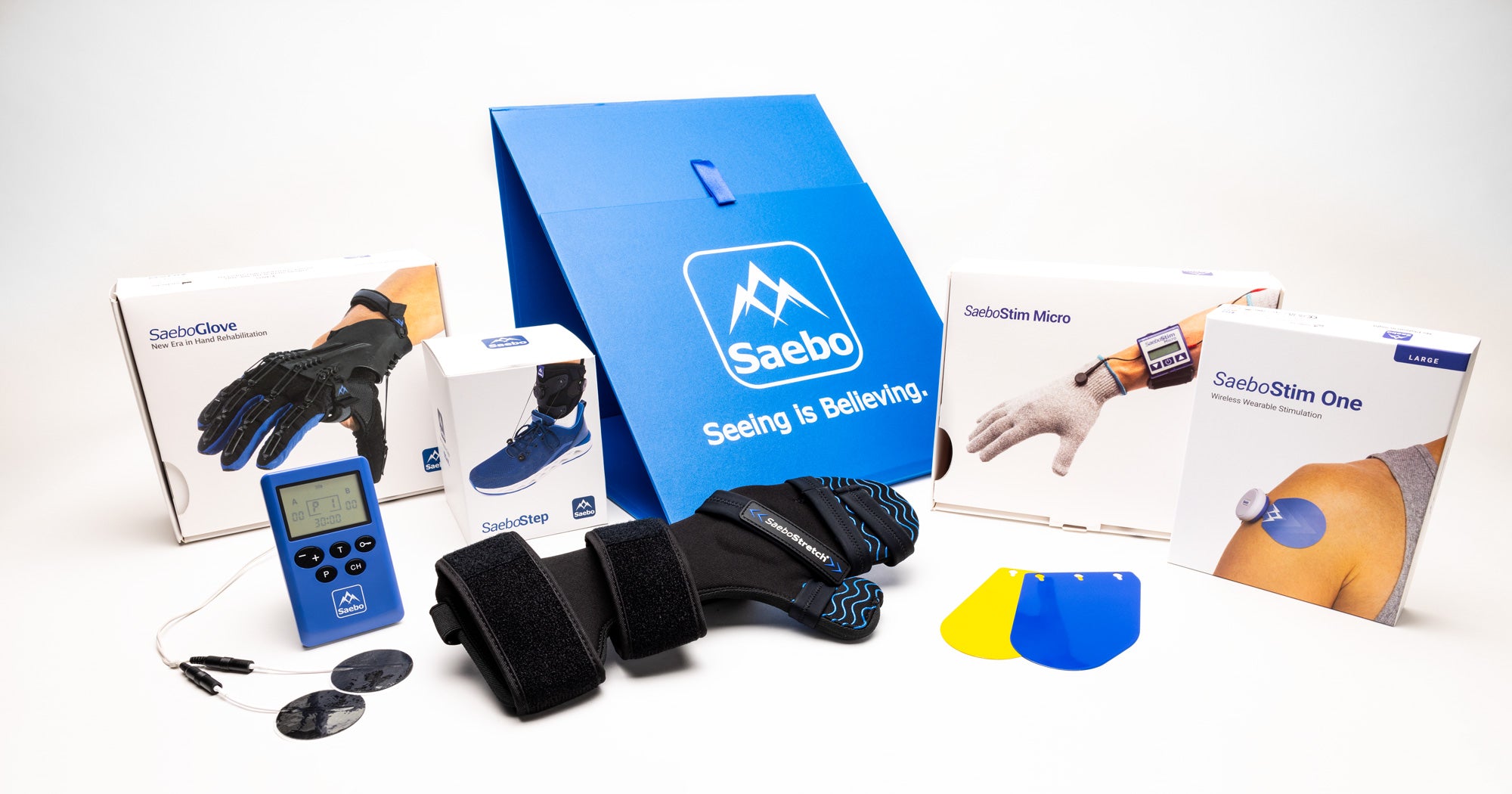
Spastic muscles show different activation patterns during passive stretch versus active contraction. Active stroke spasticity exercises engage neural pathways connecting the brain to muscles, strengthening motor control, improving function, and reinforcing neuroplasticity. Devices such as the SaeboGlove and SaeboStretch can support repetitive, task-specific movement, which plays a critical role for improving hand function after stroke. Consistent active exercise promotes creation and reinforcement of new neural pathways. Recovery of strength and motor function is attributed to cortical plastic reorganization, whereas spasticity involves different mechanisms for why it happens.
Saebo is widely used in stroke rehabilitation to support active movement and help patients regain functional use of the hand and arm.
Evidence-based spasticity treatment exercises and interventions that actually work
A multidisciplinary approach that combines medication and physical therapy guides effective spasticity treatment. Reducing spasticity alone without addressing negative components of upper motor neuron syndrome limits meaningful recovery. Evidence supports specific rehabilitation techniques that aid functional improvements.
Task-specific training and active movement exercises
Task-specific training combined with cognitive sensorimotor exercise provided most important improvements in proprioception, spasticity, and gait speed after eight weeks of training. This approach focuses on repetitive, goal-directed practice of functional tasks rather than isolated muscle strengthening. The intervention increases lateral, static, and dynamic balance to promote functional mobility in stroke patients at the chronic stage. Practicing real-life activities such as reaching, grasping, walking, and transfers—augmented with Saebo-assisted exercises for hand and arm function—creates neural pathways that restore motor control, reduce spasticity, and improve functional independence.
Electrical stimulation to reduce spasticity
Neuromuscular electrical stimulation (NMES), especially when combined with task-specific exercises, can help reduce spasticity in both the arms and legs after stroke. It works by activating weakened muscles and improving movement patterns.
Research shows that applying electrical stimulation to muscles like the ankle dorsiflexors or wrist and finger extensors can improve mobility, reduce muscle tightness, and support better functional outcomes (3). Functional electrical stimulation (FES) has also been shown to improve range of motion and motor control in individuals with wrist and hand spasticity.
Overall, NMES is most effective when used alongside active rehabilitation exercises rather than as a standalone treatment.
Prolonged positioning and dynamic splinting
Dynamic splints, like SaeboStretch, gently stretch the fingers, hand, and wrist for long periods, usually during rest or sleep, to reduce spasticity after a stroke. They are typically worn 6–12 hours per day for up to four months. Research shows the biggest improvements in finger flexor spasticity occur by three weeks, and wrist and finger flexor spasticity improve by six weeks when worn at least six hours daily (4). As spasticity decreases, users often increase wear time to around 7.9 hours per day.
Neuromuscular re-education techniques
Proprioceptive neuromuscular facilitation uses cutaneous, proprioceptive, and auditory input to produce functional improvement in motor output. Proprioceptive neuromuscular facilitation (PNF) applied to both affected and unaffected sides improves abnormal muscle tone and stiffness from upper motor neuron lesions, and integrating PNF with Saebo-assisted exercises can accelerate functional hand and arm recovery post-stroke. The technique stimulates proprioceptive organs in muscles and tendons to improve muscular functions and promotes exploration of postural reflexes.
Combining multiple approaches to get better outcomes
Multimodal therapies produce superior outcomes compared to single interventions. Combination treatments that include stretching, splinting, and botulinum toxin are considered multimodal approaches. Studies support that the addition of many more treatment modalities after medical intervention, rather than the type of treatment modality, is vital to attaining active goals. Grade A evidence supports multimodal therapy in post-stroke spasticity treatment, with interventions showing effectiveness to improve functional recovery and quality of life.
Conclusion
Passive stretching offers temporary relief, but modern spasticity management requires a complete approach. Task-specific training coupled with electrical stimulation and neuromuscular re-education creates lasting improvements by rewiring neural pathways rather than lengthening tight muscles.
Stroke recovery is optimized by combining multiple evidence-based interventions—task-specific training, NMES, dynamic splinting, and Saebo-assisted hand and arm exercises—that target both the neurological cause and functional limitations, promoting lasting improvements in motor control and independence. You'll build the motor control necessary to achieve meaningful, long-term improvement when you focus on active movement exercises that challenge your nervous system.
References
- https://www.frontiersin.org/journals/neurology/articles/10.3389/fneur.2020.616097/
- https://doi.org/10.1016/j.apmr.2008.02.015
- https://pubmed.ncbi.nlm.nih.gov/26292692/
- https://www.medicaljournals.se/jrm/content/html/10.2340/16501977-0807
All content provided on this blog is for informational purposes only and is not intended to be a substitute for professional medical advice, diagnosis, or treatment. Always seek the advice of your physician or other qualified health providers with any questions you may have regarding a medical condition. If you think you may have a medical emergency, call your doctor or 911 immediately. Reliance on any information provided by the Saebo website is solely at your own risk.
